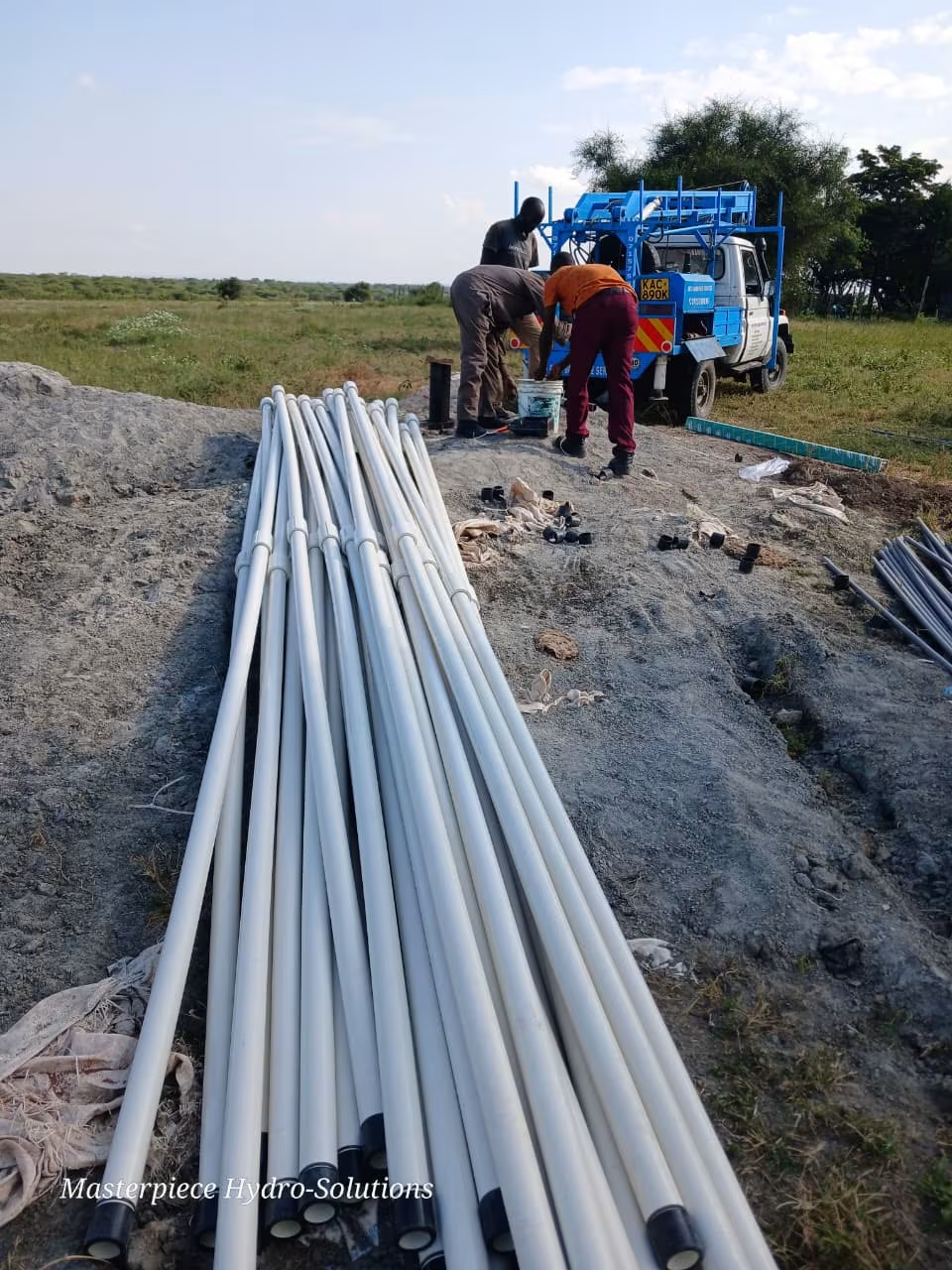
Borehole drilling quote preparation helps a contractor understand your site before attaching a price to the work. A useful enquiry explains the location, available evidence and intended water use. It also marks what you do not yet know. This gives the supplier a clearer basis for assessment and questions.
Begin with Masterpiece Hydro-Solutions borehole drilling services and send your drilling enquiry for assessment. You do not need to invent missing technical details. Instead, share the records you hold and ask which next step will turn an initial estimate into a defined proposal.
Decide which decision the quote should support
First, tell the contractor whether you need early budget guidance or a proposal for an assessed project. These requests need different levels of certainty. An owner exploring feasibility should not expect the same detail as one who already has site records and an agreed scope.
Next, identify the boundary of your request. Do you want drilling only, or do you need the supplier to explain the later project stages? A broad water-supply objective helps with planning, but the contractor must still distinguish the work it can price now from work that needs further evidence.
Also, state any real decision deadline. For example, a committee may need information for a meeting before it approves the next assessment. Share that context without demanding an unsupported final price. The contractor can explain the level of detail it can reasonably provide.
Start borehole drilling quote preparation with site identity
Provide the county, general location and a clear way to identify the property. If you share a map pin, check that it points to the intended site. Also, identify the person who can answer access questions. An incorrect location can undermine otherwise careful enquiry information.
Explain the site’s current use and whether other construction activity may affect access. For example, a proposed building layout may differ from what a site photograph shows today. Tell the contractor which version reflects the intended works so it can ask the right planning questions.
Borehole drilling quote preparation should also identify the client representative. State who gathers information, who owns the decision and who can authorise a site visit. This reduces confusion when a landowner, project manager and funding committee all participate in the same enquiry.
Describe water use without selecting a pump
Tell the contractor why you need the borehole. Domestic supply, irrigation and an institution may create different demand patterns. Also, describe whether another source already serves the site. A proposed borehole may supplement that source rather than replace every part of the existing supply.
If you hold water-use records, share their period and basis. If you only have an estimate, label it clearly. For example, a planned development’s future demand remains an assumption until the project brief supports it. Avoid turning a rough user count into a precise production promise.
You do not need to choose a motor size to request drilling information. Pump selection comes from assessed source evidence and the required duty. Therefore, describe the intended service first. Leave equipment selection to a suitable later assessment rather than guessing specifications in the enquiry.
Gather existing reports and mark their limits
Collect any hydrogeological survey, site plan or relevant previous borehole records that you may legitimately share. Include dates and identify which property each document concerns. Nearby information can provide context, but it does not establish the conditions or outcome at your site.
Next, tell the contractor if a report refers to an earlier layout or a different proposed drilling position. Do not remove that context to make the document appear more decisive. The qualified assessor needs to understand which information remains applicable and which questions require further work.
If you lack a survey, say so. You can ask about hydrogeological survey assessment as a separate step. Borehole drilling quote preparation should expose missing evidence early, rather than disguise it with a depth copied from another owner’s project.
Build a borehole drilling quote preparation pack
Organise the enquiry so the reader can distinguish facts from assumptions. The following structure helps a contractor identify what it knows and what it must still assess. It does not require the owner to perform specialist investigations.
| Enquiry item | What to provide | If it remains unknown |
|---|---|---|
| Site identity | Location, map reference and contact | Clarify before requesting a visit |
| Water objective | Intended uses and available demand records | Label the planning assumption |
| Existing evidence | Dated reports and relevant plans | Ask which assessment comes first |
| Physical access | Honest description and current photographs | Request professional site review |
| Permission position | Available correspondence and current stage | Ask the authority for requirements |
| Commercial request | Scope to price and decision purpose | Request a staged proposal |
Finally, include a short list of open questions. A well-labelled unknown gives the supplier a useful task; an unmarked guess can become an unreliable quotation assumption.
Share access information that needs assessment
Describe the route from the public road to the proposed working area. Also, mention known gates, steep sections, overhead obstructions or other constraints. Photographs can help the contractor plan a review, but they do not replace its assessment of rig access and safe working requirements.
Do not promise that a route will suit machinery simply because a smaller vehicle uses it. Instead, ask the contractor to confirm its requirements and identify any owner preparations. Keep those preparations within a written scope. Owners should not attempt machinery access work without suitable professional advice.
Also, describe shared access arrangements and the contact who can coordinate entry. If other occupants or contractors use the site, explain the situation. This helps the provider ask about practical scheduling dependencies before it commits to mobilisation assumptions.
Explain the permission stage accurately
Send relevant authority correspondence and identify its date. However, do not describe a preliminary enquiry as final permission. The Water Resources Authority’s water-use allocation guidance provides an official starting point for understanding the application process. Confirm current site-specific requirements directly with WRA.
Ask the proposed contractor which coordination or documentation services it can include. Also, identify what remains the owner’s responsibility. Assistance with an application does not guarantee an authority’s decision. The quotation should make that boundary clear before you rely on an anticipated programme.
For borehole drilling quote preparation, accurate status matters more than technical-sounding language. If you do not know the stage, share the available correspondence and ask for clarification. Avoid quoting unverified fees, approval periods or assumptions copied from an unrelated project.
Use a school-project enquiry scenario
Consider an educational example of a school planning an additional water source. The school holds a site plan and past consumption records but lacks a current survey. Its committee needs to decide which assessment to fund. This example does not describe an actual client or project.
First, the school sends the location, available records and a description of term-time use. Next, it identifies the missing survey and asks for a staged proposal. The contractor can then explain the initial assessment scope and which later pricing decisions depend on its findings.
This approach makes borehole drilling quote preparation useful even before every technical detail exists. The school receives a defined next step instead of a falsely precise complete project price. It can also keep committee decisions aligned with the evidence available at each stage.
Use borehole drilling quote preparation to test assumptions
When the contractor replies, check whether it understood your site and intended scope. Ask it to list the information used and the assumptions behind its proposal. Also, request a distinction between confirmed work and provisional items. This turns the reply into something you can review meaningfully.
Next, correct any misunderstanding before comparing the quotation with another provider’s offer. A wrong access assumption or omitted testing scope can distort the comparison. Send the same clarification to all bidders where it affects the common project brief.
Finally, ask about validity, tax treatment and the process for later changes. These questions matter even when the initial request concerns planning. An early estimate should state what would trigger revision, rather than quietly becoming a commitment after the project’s assumptions change.
Questions about preparing a drilling enquiry
Can I ask for a quote without a survey?
Yes, but explain that the survey remains outstanding. Ask whether the provider can offer early guidance and a separate assessment proposal. The response should state its limits. Do not treat an initial planning figure as a site-confirmed drilling or complete water-supply price.
Should I copy a neighbour’s borehole depth?
You may share relevant nearby information as context, with its source and limits. However, it does not establish the correct depth or likely yield on your property. Ask the qualified assessor how it informs the investigation. Avoid presenting another owner’s result as your project’s specification.
What if I do not know my daily water demand?
Describe the intended uses and any available consumption records. Also, identify planned changes, such as more occupants or a new irrigation area. Label estimates rather than inventing precision. The contractor can explain which demand assessment would improve the brief before later equipment selection.
Do photographs replace a site visit?
Photographs can make the first conversation more useful, particularly when they show access and the working area. However, the contractor must decide whether it needs a site review. Ask which assumptions remain unconfirmed. A photograph cannot establish every ground, clearance or machinery-access condition.
How do I keep several contractors’ replies comparable?
Use one dated enquiry pack and send material clarifications to each bidder. Ask every provider to identify inclusions, exclusions and unresolved assumptions. Then compare scope before totals. Borehole drilling quote preparation supports a fair comparison only if the replies address the same project and evidence.
Send a clear first enquiry
Gather your location, available reports, access description and water-use objective. Mark the unknowns and identify the decision you need to make. Then request an assessed drilling proposal from Masterpiece Hydro-Solutions. A clear enquiry helps the contractor explain the next step without turning missing evidence into unsupported certainty.