

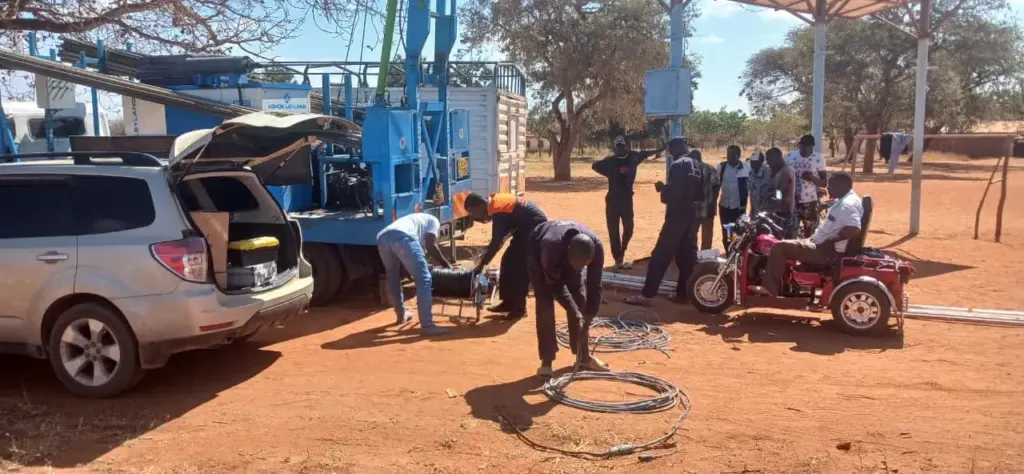
A drop in output does not automatically mean the borehole itself has failed.
A borehole can produce less water because of changes in groundwater levels, pump performance, pumping rates, borehole condition, the condition or efficiency of the power source, or wider groundwater conditions. The same symptom can have different causes, so the cause should be established before deciding what, if anything, needs to be fixed.
In simple terms, if you’re getting less water from your borehole than you used to, the important question is what has changed. The groundwater source, the borehole, the pump and the way the system is being used can all affect how much water you receive.
Common reasons a borehole may produce less water
Pump wear or pump performance problems. Pumps can lose efficiency as they age. A pump that was correctly sized when installed may no longer meet the system’s current demand if water use has increased. From the surface, a weakening pump can look very similar to a weakening borehole, even though the problem is with the equipment rather than the groundwater source.
Power-system problems. The power system supplying the pump can also affect water delivery. This is particularly relevant for solar-powered systems, where changes in system performance or efficiency can affect how the pump operates. A problem with the power supply can therefore appear as a reduction in borehole output even when the borehole itself has not changed.
Screen or casing blockage. Water enters a borehole through openings in the screened section. Over time, fine sediment, mineral deposits or biological growth can build up around these openings and restrict the flow of water into the borehole. The groundwater may still be available, but the borehole may no longer allow it to enter as easily as before.
Excessive drawdown or unsustainable pumping. When a borehole is pumped, the water level around it falls. This is called drawdown. If water is being pumped faster than the borehole and surrounding aquifer can sustainably supply it, the water level can fall significantly while the pump is running and may take longer to recover afterwards. Increased demand or interference from nearby boreholes can contribute to the problem.
Regional aquifer decline. Groundwater levels can also decline across an area when groundwater abstraction is heavy, recharge is limited, or prolonged drought affects groundwater replenishment.
This is a documented concern in parts of Kenya. Research on the Nairobi Aquifer System found that groundwater abstraction increased tenfold from the mid-1970s. Groundwater levels beneath Nairobi have declined at a median rate of about 6 metres per decade since 1950, with an average decline of about 4 metres across the wider aquifer area and up to 46 metres beneath Nairobi itself (Oiro et al., 2020)
These figures are specific to the Nairobi Aquifer System. They should not be treated as a national rate of groundwater decline.
For an individual borehole, reduced output alone cannot establish that regional aquifer decline is the cause. It needs to be distinguished from pump, power-system, borehole and usage-related problems.
Kenya also has a national groundwater monitoring network managed through the Water Resources Authority. Longer-term groundwater-level data can help assess regional groundwater trends.
Is the borehole yield lower, or is the pump delivering less?
What comes out of your pipes is not necessarily a direct measure of how much water the borehole can sustainably produce.
The pump, water level, pumping rate, pipework and condition of the borehole all affect the amount of water you actually receive.
For example, the groundwater may still be available, but the pump may be underperforming. Or the borehole may be restricting the amount of water entering it. Or the current pumping rate may simply be too high for the borehole to sustain.
The result can look the same from the surface: less water than before.
But the solution will be different in each case.
Why the right solution depends on the cause
Several of these problems can produce almost identical symptoms.
A pump nearing the end of its working life and a partially blocked screen can both look like “the borehole is producing less water.” But one may require attention to the pumping equipment while the other may require work on the borehole itself.
That’s why replacing the pump, cleaning the borehole or drilling deeper should not be assumed to be the right first response.
The cause should be established first.
How to find out what has changed
If your borehole’s output has dropped and you’re not sure why, the next step is to assess the system rather than guess at a fix.
The assessment should look at both the borehole and the equipment supplying water from it. Depending on the borehole and the records available, this may include:
- Checking water levels when the borehole is at rest and while it is being pumped
- Assessing pump performance to establish whether the pump is still delivering as expected
- Checking the power system, particularly for solar-powered systems, to establish whether it is still supplying the pump as required
- Reviewing previous records, including drilling reports, pumping-test results and earlier water-level readings
- Assessing the borehole’s condition to identify possible restrictions to water entering the borehole
- Comparing past and current performance to see when the change occurred and how significant it is
The aim is not simply to confirm that you’re getting less water. It is to establish where the change is occurring and what may be causing it.
Records worth having ready
If you have any of the following, sharing them can help narrow down the possible causes before a site visit:
- Drilling or borehole completion report
- Pumping test results
- Pump specifications
- Maintenance history
- Previous water quality reports, if relevant
You don’t need to have all of them. Whatever records you have can still be useful.
Has your borehole’s output changed?
Tell us what you’re experiencing and, if available, share your previous borehole, pumping or maintenance records.
This can help establish what has changed and what needs to be assessed.
Have an existing borehole? Tell us what’s changed → Contact us today
Further reading
Oiro, S., Comte, J-C., Soulsby, C., Macdonald, A. & Mwakamba, C. (2020). Depletion of groundwater resources under rapid urbanisation in Africa: recent and future trends in the Nairobi Aquifer System, Kenya. Hydrogeology Journal, 28, 2635–2656.
Kuria, Z. (2013). Groundwater Distribution and Aquifer Characteristics in Kenya. In Kenya: A Natural Outlook, Chapter 8, pp. 83–107. The analysis drew on more than 13,000 borehole records to examine groundwater distribution and aquifer characteristics across Kenya.
Water Resources Authority (WRA). Groundwater Assessment & Monitoring.