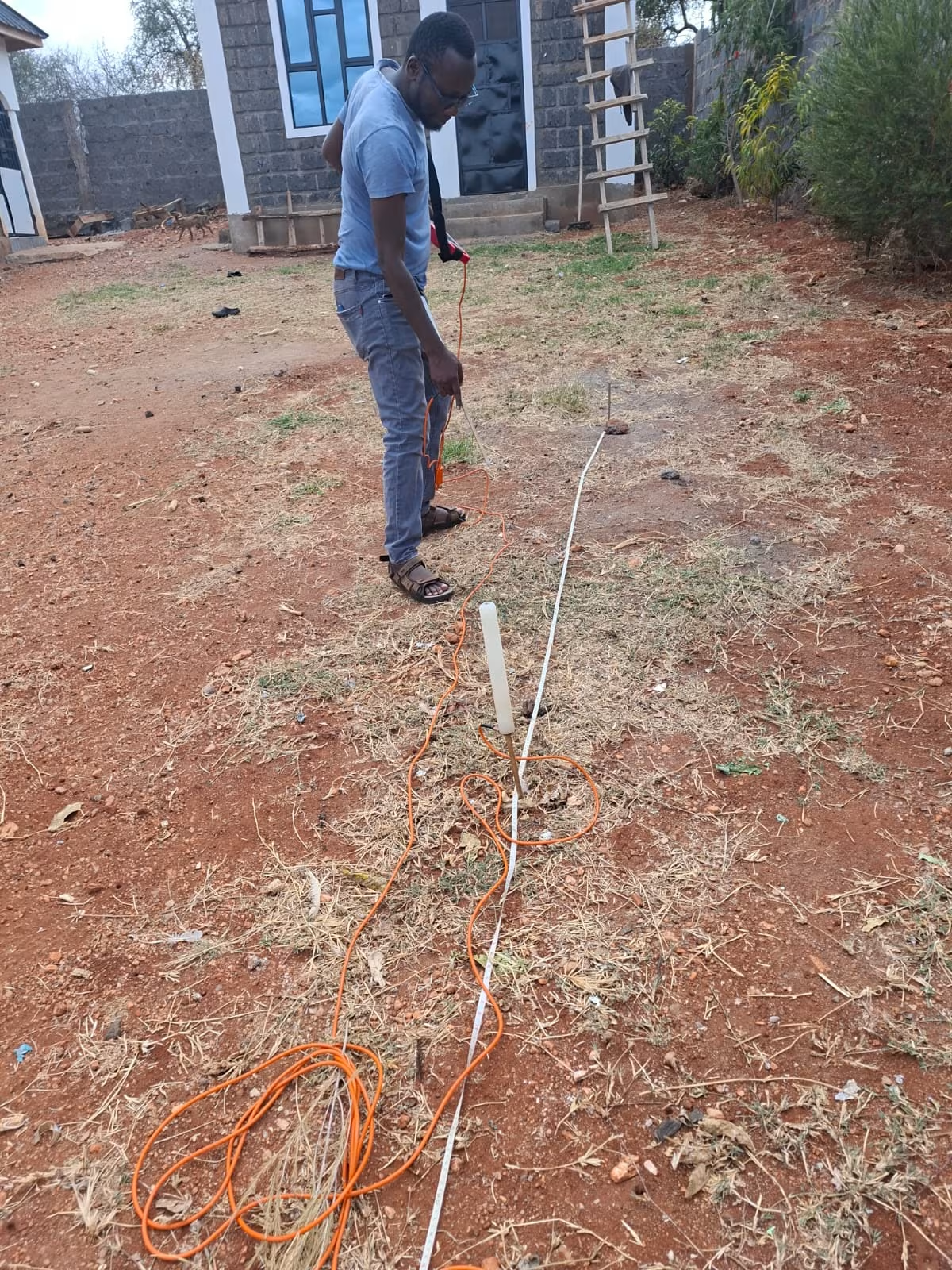
Borehole depth handover evidence should identify which depth the client needs documented and how the responsible professionals support that statement. Drilled depth, accessible camera depth and equipment position are not interchangeable. First, agree the measurement question and reference. Then preserve construction records, later observations and any limitations instead of accepting one unexplained number as complete proof.
Explore Masterpiece Hydro-Solutions hydrogeological surveys and request a depth-evidence assessment enquiry. Ask what professional scope may be available. This guide concerns client handover and traceable records, not instructions for measuring down a borehole or a guarantee that every historical depth can be verified.
Start borehole depth handover evidence with the agreed statement
Ask what the client expects the record to establish. The question may concern completed drilling, a present accessible extent or an equipment record. Those statements need appropriate evidence and explanation. Also, identify the asset and relevant project stage so a later reader understands which source and period the document describes.
Keep the original scope alongside the handover request. If the project changes its evidence requirement, ask the responsible provider to explain the additional task. A general demand for proof should not silently combine several measurements or imply that one method can answer every depth-related question.
Separate depth and water-level terms before comparison
Drilled depth describes the completed hole. Static and pumping water levels concern observations under stated conditions. Pump setting depth concerns equipment position. An accessible inspection extent describes what that visit reached or assessed. The owner should not treat these as different labels for one universal depth figure.
Ask qualified preparers to explain the reference point, units and purpose of each record. Agriculture and Agri-Food Canada’s monitoring guidance illustrates why consistent references matter. Use that record-management principle without importing its methods or schedules as universal requirements for a Kenyan handover.
Use a borehole depth handover evidence table
The table supports a discussion with the responsible professionals. It does not identify a required method or certify a particular measurement. Ask which evidence fits the client’s actual question. Also, keep uncertainty visible where a record or accessible area cannot establish the intended statement.
| Depth-related statement | Evidence question | Limit to preserve |
|---|---|---|
| Completed drilled depth | Which construction record and measurement basis support it? | A later accessible extent is not automatically the same observation |
| Present inspection extent | What did the visit actually reach and assess? | Unseen or inaccessible areas remain unknown |
| Pump setting | Which installed-equipment record supports the position? | Equipment depth does not establish total drilled depth |
| Water level | What conditions and reference apply? | A level observation is not a construction-depth certificate |
| Changed or conflicting figure | Which preparer can explain the difference? | Do not edit one number merely to match another |
| Client acceptance statement | What has the project actually demonstrated? | A summary must retain material limitations |
Review original construction evidence on its own terms
Gather the drilling and completion records with relevant approved changes. Identify their preparers and issued versions. Also, distinguish a proposed depth from a completed-work statement. An early estimate or tender assumption should not silently become the final record simply because the project later produced water.
The borehole drilling service offers a relevant enquiry route for construction-scope questions. Ask what the original records establish and which clarification belongs with their preparers. A present assessment should not pretend to recreate undocumented historic observations with certainty.
Keep a camera observation within its actual coverage
If a visual investigation forms part of the handover evidence, request the inspected extent and relevant reference in the report. Ask what limited access or image conditions left unknown. The borehole inspection service provides a separate enquiry route for an identified visual question.
Do not treat the end of a camera run as proof of the original bottom without professional explanation. Borehole depth handover evidence should distinguish the observation from an inferred construction conclusion. A useful report can state a limited finding honestly without claiming complete historical verification.
Work through an illustrative record discrepancy
Consider an educational completion record stating 220 metres, while a later investigation records accessible observations to 160 metres. These are arbitrary figures, not actual project results or recommended site depths. The two numbers alone do not explain the difference or establish that either document is false.
First, ask the responsible preparers what each figure measures and which reference applies. Next, identify the actual extent and limitations of the later visit. Further assessment may be necessary for a particular question. The owner should not simply replace the completion depth with the smaller number to make the file look current.
Borehole depth handover evidence then becomes an explained record rather than a numerical dispute. The client can understand which statement is supported and what remains unknown. A professional should connect conclusions with evidence, while the owner preserves the complete context for future decisions.
Agree observation responsibilities before the visit
Ask which qualified professional will obtain and interpret any proposed measurement. Identify the purpose and reporting deliverables before scheduling. Also, clarify technical access and equipment-handling responsibilities. Owners can provide records and coordinate entry without attempting downhole measurements or improvising a method to satisfy the handover request.
If another adviser will review the result, agree how they receive the issued record and supporting context. A detached photograph of a display may omit important conditions. The client should receive an explanation that remains understandable after the original team leaves, not only a verbal assurance given during the visit.
Handle contradictions through traceable clarification
List conflicting figures with their source documents and dates. Ask the responsible preparers to explain whether they describe different features, references or arrangements. Also, identify any genuine correction and current version. The owner should not remove an older value without preserving the reason for the change.
Borehole depth handover evidence benefits from an explicit gap list. If the professional cannot establish a particular historic fact, the final statement should say so. An honest limitation is more useful than a precise-looking certificate that exceeds the available record or method.
Keep depth separate from yield and water quality
A confirmed construction depth does not establish sustainable source supply. Appropriate performance evidence and interpretation address that separate question. Likewise, a deep source cannot guarantee drinking-water suitability. Arrange relevant analysis and advice for intended uses rather than treat any depth figure as a quality assurance.
Installed pump capacity and user demand also remain distinct from source availability. A larger motor cannot create groundwater. If equipment planning follows handover, the qualified team needs current source evidence and the actual delivery duty. The owner should not choose a package from the depth number alone.
Confirm the wider record and authority context
Use WRA’s official guidance to frame current project-specific questions about completion evidence and stage. Ask the authority and advisers what records the actual source needs. A client depth statement does not automatically replace another document or determine every administrative question.
Keep the depth explanation within the full handover index. Include asset identity, relevant construction records and unresolved actions. Also, retain later changes and clarifications. A future assessor should understand what the client accepted as evidence without guessing the meaning of a short summary.
Questions clients ask about depth proof
Can one number serve every depth-related purpose?
No. Ask which feature the statement describes and how it was established. Borehole depth handover evidence should distinguish completed drilling, equipment position, water levels and accessible inspection extent. Different figures can all be relevant without being interchangeable proof of the same thing.
Does the camera’s displayed depth prove the original drilled depth?
Ask the professional to explain the observation, reference and limits. A present accessible extent does not automatically reproduce a historic construction measurement. Keep actual coverage and unknown areas visible. The client needs a defensible statement rather than an assumption based only on a display.
Should the owner measure with a weight or tape?
Leave technical measurement and access assessment to qualified personnel. Owners should not introduce objects into the source or attempt equipment handling. Provide records and explain the question instead. The professional should propose an appropriate scope and account for its limitations.
What if the historic record cannot be confirmed fully?
Retain what the available evidence supports and state uncertainty honestly. Ask whether further assessment could address a defined gap. Do not invent a complete historical verification. The client can make a clearer next decision when limitations remain visible in the file.
What should accompany an enquiry?
Send the source identity, depth-related records and exact handover statement requested. Include references, dates and known access constraints. Finally, identify conflicting figures and the responsible contact. This helps the provider define an appropriate assessment without guessing which depth the client means.
Request an explained depth statement
Use borehole depth handover evidence to connect the client’s question with appropriate records, references and professional explanation. Preserve distinctions and uncertainty before acceptance. Finally, retain the supporting file. A useful statement is traceable and bounded, rather than an unexplained figure expected to prove every source outcome.
Request a depth-evidence assessment enquiry from Masterpiece Hydro-Solutions. Explain what the client needs documented and the records available. Ask which professional scope may be available and which historical or authority questions require separate confirmation.