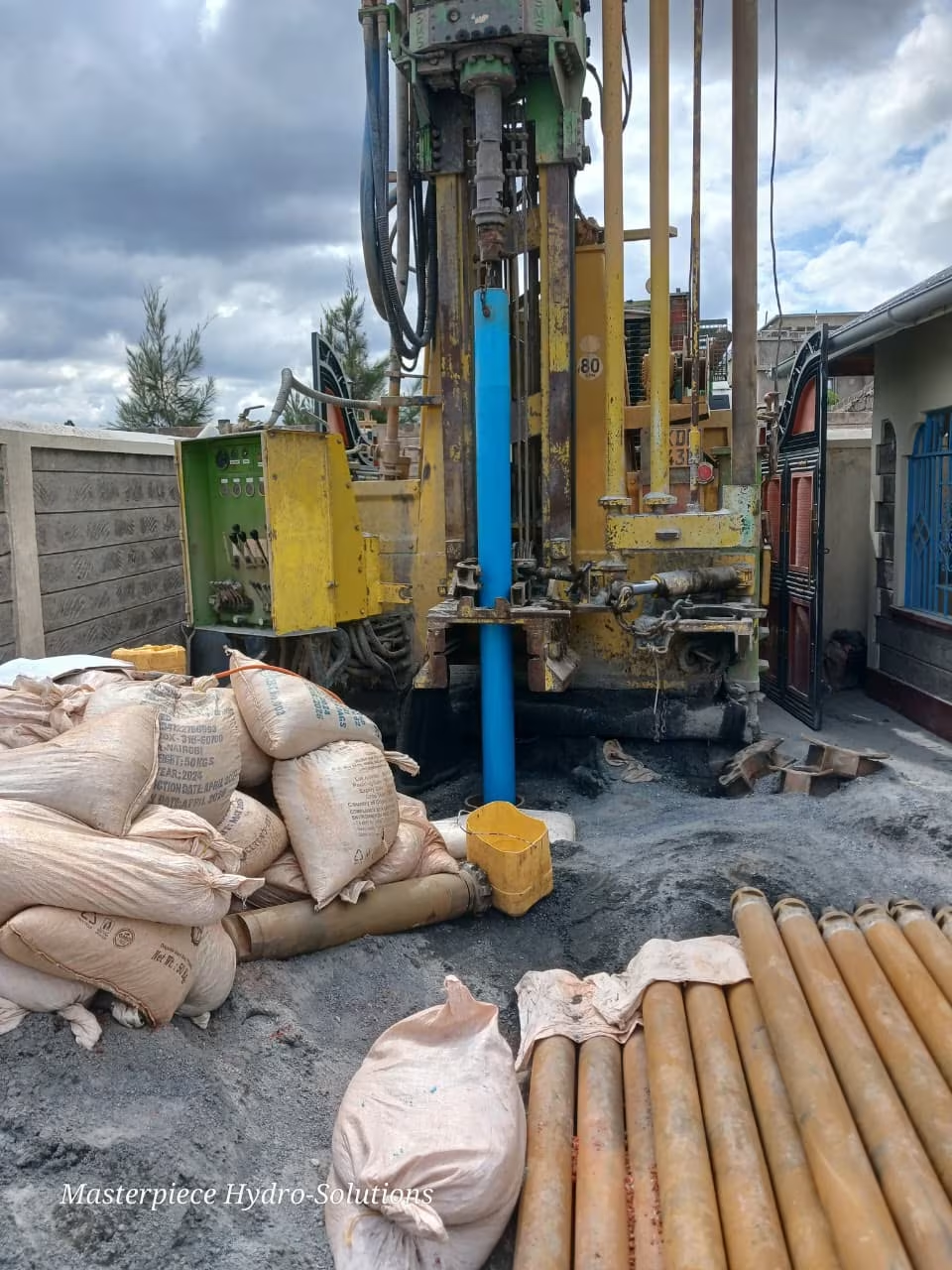
Borehole drilling casing costs need a defined construction basis before the numbers become useful. A material label and a per-metre figure do not tell you every specification or included activity. First, ask a qualified practitioner to explain the proposed construction. Then compare the quantities and commercial boundaries attached to it.
See Masterpiece Hydro-Solutions borehole drilling services and request a site-specific drilling and casing quotation. Share your available survey records and any existing specification. Ask the provider to identify what the drilling rate already covers before you add separate material or installation items.
Separate the material decision from the estimate
Casing forms part of an assessed borehole construction arrangement. The appropriate specification depends on the project, not simply the lowest displayed rate. Therefore, ask who determines the material, dimensions and relevant construction details. The owner needs a clear explanation without trying to design the borehole.
Next, ask whether the proposal’s material description represents a confirmed requirement or an initial assumption. Early estimates may not include every detail that later findings inform. If a specification remains provisional, the quotation should explain what evidence will finalise it and how changes will reach the owner.
Also, avoid treating every metre associated with the project as the same quantity. The commercial schedule should identify what each line measures. A clear description helps you understand the commitment and prevents confusion between the drilling quantity and separately stated construction items.
Read borehole drilling casing costs from the source
The Masterpiece quote estimator, checked on 26 November 2026, displayed a steel-casing drilling estimate input of KSh 6,300 per metre. Its PVC estimate input was KSh 5,800 per metre. These are the displayed inputs from that dated check.
They are not standalone observed casing-supply prices or Kenyan market averages. They also do not establish a complete commissioned water-system price. The written site quotation must explain the actual scope. In addition, the estimator does not state VAT treatment, so ask whether VAT is included.
Use these figures to ask better questions about borehole drilling casing costs. Do not assume the displayed difference proves that one material will save a fixed amount on your project. Suitability, actual quantities and included work must first support a comparable assessment.
Ask for a specification you can identify
A useful proposal identifies the material and the relevant specification, rather than relying on “good quality” or “heavy duty”. Ask the qualified provider which details matter for its recommendation. Also, request clear identification of any proposed alternatives so you can recognise a later substitution.
The provider should explain the role of the specified components within the assessed construction. The owner can then understand why the quotation contains them. However, the owner should not select dimensions or construction methods from a general article. Those choices need project-specific professional judgement.
Next, ask how the contractor will record the material actually installed. A final construction record should connect the completed work to the agreed specification and approved changes. This matters for later assessments as well as for checking the original purchase.
Compare borehole drilling casing costs consistently
Before comparing totals, align the technical and commercial descriptions. The following table helps identify the information each bidder must explain. It does not rank steel and PVC or prescribe a construction arrangement.
| Comparison question | What to request | Risk of leaving it unclear |
|---|---|---|
| Which material does the proposal assume? | Identifiable specification and selection basis | Comparing unlike construction options |
| What does the rate already cover? | Written drilling and casing scope | Omitting work or counting it twice |
| Which quantity drives each charge? | Estimated quantity and measurement method | Confusing different line-item quantities |
| What remains provisional? | Confirmation evidence and approval process | Unexpected changes without a clear basis |
| Who supplies and installs the components? | Responsible party and scope boundary | An unresolved delivery interface |
| What confirms completed work? | Construction record and agreed commercial evidence | A final invoice that cannot be reconciled |
As a result, borehole drilling casing costs become part of a transparent proposal. Resolve specification differences before deciding which commercial offer better serves the project.
Use the estimator arithmetic without overreaching
For a hypothetical 100-metre quantity, the displayed steel input produces KSh 630,000. The displayed PVC input produces KSh 580,000. Each calculation simply multiplies the dated rate by the assumed quantity. Neither figure represents a complete project quotation or a recommended depth.
Also, these calculations do not establish a separate casing-material budget. The estimator labels relate to its drilling estimate basis. Therefore, ask what the rate includes before adding another casing amount. Otherwise, you could count the same scope twice while believing you are building a more careful budget.
Finally, keep tax and other project categories visible. The estimator’s VAT position remains unspecified. Ask for a written explanation of the final scope and applicable tax treatment. A limited arithmetic example should remain limited even when it looks like a convenient funding figure.
Track borehole drilling casing costs through quantities
The quotation should explain how the parties agree chargeable quantities. Ask which records show actual progress and completed construction. Also, identify who may confirm those records for the owner. This supports commercial review without requiring the owner to perform specialist measurements or supervise technical methods.
Next, distinguish a quantity assumption from a promised outcome. An estimated drilling length does not guarantee a particular source or water quality. The contractor should explain how new findings affect decisions within the agreed scope. Ask how it communicates those decisions before additional commitments arise.
Borehole drilling casing costs should therefore connect to documented quantities and approved scope. If a final invoice changes, request the corresponding record and explanation. A revised figure alone does not show whether the change came from measurement, specification or another work category.
Keep related completion work visible
A casing-related line does not automatically define every part of completing a borehole. Ask the contractor which associated components and activities its proposal includes. The qualified team should explain their purpose and selection. Owners need scope clarity rather than instructions for constructing or sealing a borehole.
Also, ask whether development, test pumping and the relevant reports sit inside or outside the stated price. These activities answer different questions from the supply of material. A detailed construction specification can still leave important project stages excluded.
For permission and completion-information questions, consult the Water Resources Authority’s water-use allocation guidance. Confirm current requirements directly with WRA for the project. Then ask which documentation support the contractor includes and which responsibilities remain with the owner.
Compare a bundled and itemised proposal
Consider an educational scenario involving two unnamed proposals, without actual prices. One bundles drilling and a stated casing scope into a rate. The other separates drilling, material and installation lines. Neither structure is inherently clearer until the owner understands what each line includes.
First, the owner asks the bundled provider for its specification and quantity basis. Next, the owner checks whether the itemised provider has included every required activity without duplication. Both providers then confirm the same assessed construction boundary. Only after that clarification does the owner compare commercial totals.
This scenario shows why borehole drilling casing costs cannot depend on quotation layout alone. A short proposal may omit details, while a long proposal may repeat scope. The useful comparison rests on aligned construction, quantities and responsibility.
Discuss substitutions before purchasing
Ask how the contractor handles a proposed change of material or specification. The explanation should address suitability and the commercial effect. A substitution needs more than a statement that the alternative costs the same. The owner also needs a clear record of what changed.
Next, identify who provides the technical recommendation and who approves the commercial variation. These roles may differ. The contract should describe the communication route so the site team does not rely on an informal conversation with someone who cannot authorise the change.
Finally, ask how the final records will capture approved substitutions. Keeping the original quotation, variation and completion information together makes later review easier. It also helps future practitioners understand the actual borehole rather than relying on an early specification that no longer matches it.
Plan the budget beyond construction
A completed construction stage does not establish the full cost of useful water delivery. Testing evidence, pump selection, power and storage can create further work. Therefore, keep those categories separate when discussing borehole drilling casing costs. Do not present a construction component as an all-in water-system budget.
Explore borehole equipping services for the later assessed equipment stage. The required duty and available source evidence should guide selection. A drilled depth or casing label alone cannot specify the right pump.
Water quality also requires its own evidence. Clear water does not establish drinking-water suitability. Discuss appropriate laboratory analysis and any subsequent assessment for the intended use. Do not assume an unspecified treatment arrangement forms part of either the casing price or the eventual equipment package.
Questions about drilling and casing quotations
Are the displayed rates prices for casing pipe alone?
No. The verified figures describe inputs to the Masterpiece drilling estimator, with steel and PVC labels. Do not reinterpret them as standalone material-supply prices. Ask the provider to define the written rate scope. Also, confirm current applicability and whether VAT forms part of your quotation.
Is PVC always the cheaper complete option?
The displayed estimator inputs cannot establish that conclusion for every site. First, a qualified assessment must identify suitable construction. Then compare equivalent quantities and included activities. A lower input does not prove a particular material suits the project or reduces the full cost of a commissioned water supply.
Should drilling length equal every casing quantity?
Do not assume that every commercial line uses the same quantity. Ask the contractor to explain its construction basis and measurement method. The qualified team determines the arrangement. The owner should receive enough information to reconcile the agreed scope with the final documented work.
What if the contractor recommends a different specification?
Request the technical reason, scope effect and proposed commercial adjustment. Also, confirm the approval route before the change proceeds under the contract. Keep the revised specification with the final records. This makes the decision traceable without requiring the owner to substitute personal judgement for professional design.
Which record helps me check the final invoice?
Use the agreed measurement record, construction information and approved variations together. They should explain the quantities and scope behind the charge. If the invoice includes a new category, ask for its contractual basis. A transparent explanation matters more than whether the quotation originally used bundled or separate lines.
Request a specification-led quotation
Gather your available reports and identify the construction questions you need answered. Then request an itemised drilling and casing proposal from Masterpiece Hydro-Solutions. Ask for the specification basis, quantity method and clear exclusions. Those details connect the budget to an assessed construction rather than an isolated material label.