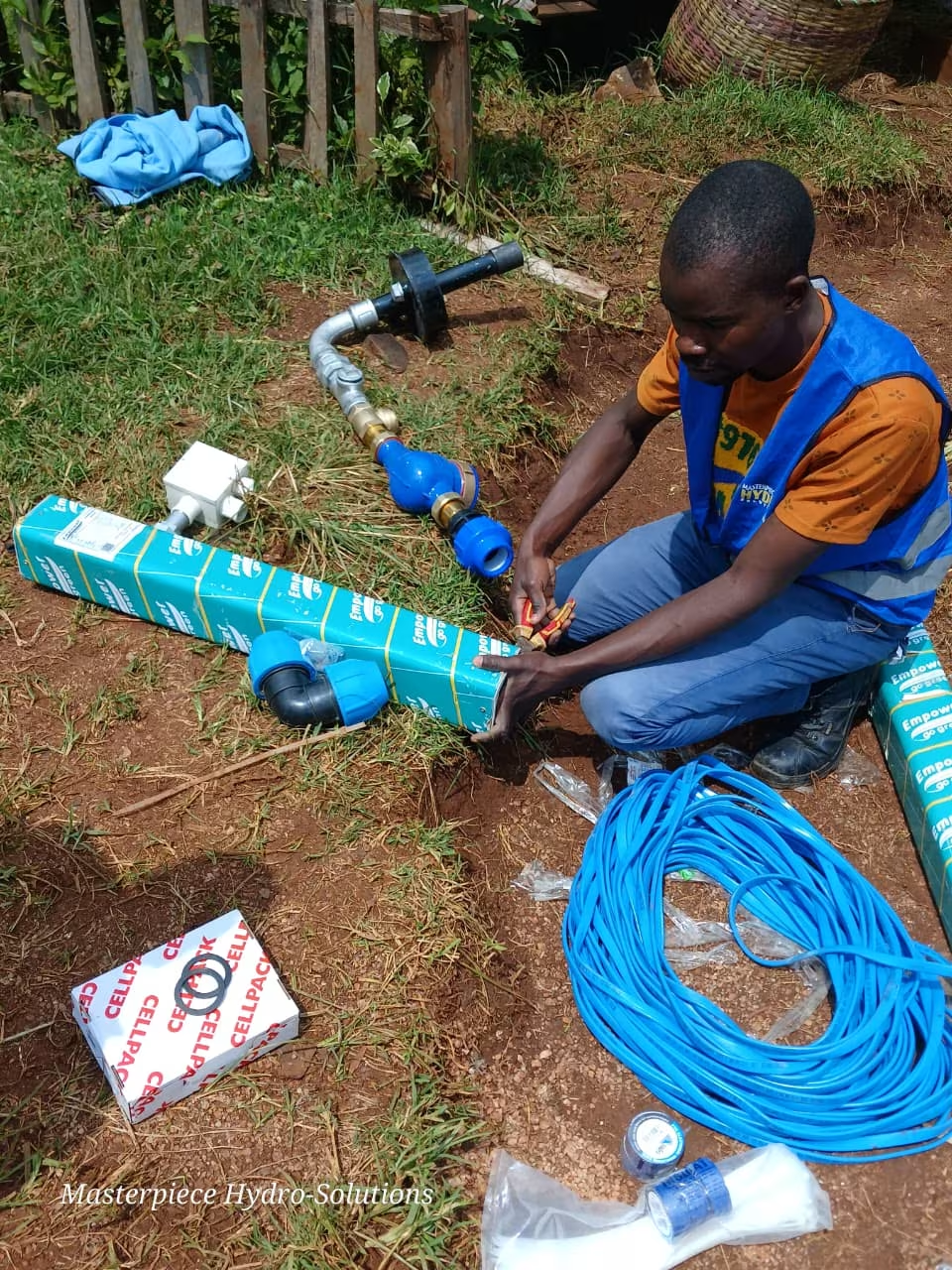
Community kiosk borehole supply should connect groundwater production with a defined dispensing service and operating arrangement. A pump’s stated capacity does not prove how much suitable water users will receive. First, describe intended users, collection patterns and responsibilities. Then assess source evidence, useful storage and the interfaces needed before the kiosk operates.
Explore Masterpiece Hydro-Solutions borehole equipping services and enquire about an assessed kiosk-source supply scope. Confirm the proposed service for your project. Share available source records and the intended dispensing brief rather than assume that an ordinary pump package includes every kiosk-management requirement.
Define the service users will collect
Describe who the kiosk is intended to serve and how the project estimated demand. Also, identify existing alternatives and the proposed source’s role. A beneficiary count can provide context without becoming a measured daily water volume.
Next, explain collection periods and the expected pattern of use. A daily total and a busy-period dispensing duty answer different questions. The project should identify relevant service requirements rather than assume that average demand describes every queue or operating interval.
Also, distinguish initial users from proposed future expansion. Additional collection points or a wider service group can change the brief. Label those assumptions and identify when qualified review is needed before the project makes a new water-service commitment.
Base community kiosk borehole supply on source evidence
Provide relevant test-pumping information and water-level records. Ask the qualified practitioner what abstraction basis they support and which uncertainties matter. Source yield, installed pump capacity and user demand remain separate. A larger motor cannot establish groundwater available for a wider community.
Next, identify known changes since the available assessment. Older records may remain useful while requiring review for the current brief. If useful information is missing, ask which further assessment would support the decision rather than fill the gap with a desired production target.
Community kiosk borehole supply needs a clear evidence gate before users rely on it. A planned source cannot be treated as a completed service. The project should understand what the available information supports and which decisions still need later tests or professional assessment.
Distinguish production from dispensing
Water may leave the borehole over one operating pattern while users collect it over another. Storage and dispensing arrangements can connect those timings, but they need an assessed basis. A strong source reading does not automatically establish the service at the collection point.
Next, identify useful storage and the relevant dispensing interface. The qualified team should explain the required flow and service arrangement. Different container and collection patterns can affect the management brief without changing the source’s sustainable production.
Also, clarify who owns the route between source, storage and kiosk. The borehole supplier may accept a source-to-tank boundary while another specialist handles the collection facility. The project needs coordinated responsibilities before treating the installation as complete.
Assess the actual pumping duty
Provide a current plan showing the borehole, tanks and agreed destinations. Also, identify relevant elevation information and known route constraints. A source outlet observation may not represent delivery to the kiosk’s intended storage location.
The Grundfos pump-selection resource explains why flow and head inform selection together. Ask the practitioner to assess pumping lift, delivery elevation, route losses and any required outlet service. Drilled depth alone cannot specify the complete package.
Next, identify existing equipment and retained components. Ask who assesses their suitability for the proposed arrangement. A new source or pump does not automatically make every existing tank control or distribution element appropriate for the kiosk brief.
Coordinate community kiosk borehole supply responsibilities
Use the table below to organise the project. It does not prescribe a governance model, dispensing standard or tariff. The relevant authorities and qualified team must confirm the actual requirements and responsibilities.
| Responsibility | Question to agree | Record to retain |
|---|---|---|
| User-service brief | Who confirms demand and collection assumptions? | Dated planning evidence and limits |
| Source operation | What production basis applies? | Relevant tests and operating assumptions |
| Water suitability | Who arranges qualified quality assessment? | Appropriate laboratory evidence and interpretation |
| Dispensing interface | Who defines and verifies the service? | Agreed delivery boundary |
| Daily management | Who records use and reports faults? | Operator instructions and contacts |
| Later changes | Who approves review and additional commitments? | Updated brief and decision record |
Next, identify unowned tasks before ordering equipment. A completed pump installation cannot replace the project’s wider operating and authority decisions.
Give quality a clear place in the operating plan
Clear groundwater and a full tank do not establish drinking-water suitability. Appropriate laboratory evidence and qualified interpretation for intended use guide that decision. Ask which quality-related work the proposed service includes and which responsibilities remain elsewhere.
WHO’s water-safety planning information addresses management across a drinking-water supply. Use that principle to involve the appropriate professionals rather than treat an equipment demonstration as the complete quality decision. This article does not define treatment or monitoring limits for the kiosk.
Community kiosk borehole supply also needs an identified person responsible for retaining results and reviewing concerns. A favourable observation at one point should not become an unsupported assurance about every later condition. Keep quality decisions connected to the operating arrangement.
Make measurement answer the right question
Decide what the project needs to know about water movement. Source production, stored volume and dispensed water are different measurement boundaries. Ask the provider what the proposed meter or record represents before using one figure as a complete service account.
Next, distinguish flow rate from cumulative volume. A busy-period reading does not establish a measured daily total without an appropriate basis. The operator should understand units, timing and the relevant record method explained at handover.
Also, name who reviews unusual patterns. The operator should report observations rather than diagnose the cause or alter protection settings. Qualified personnel must assess electrical, mechanical or source issues through a defined service scope.
Plan reserve around an actual interruption
Ask which event the reserve or backup addresses. Power loss, equipment repair and reduced source production need different responses. A second power source may address an outage while leaving sustainable-yield limits unresolved.
Next, assess useful storage against the collection service it is intended to bridge. Nominal tank capacity does not automatically equal usable reserve. The practitioner should explain operating assumptions, while management confirms priorities and any alternative supply arrangement.
Community kiosk borehole supply should state its remaining limits honestly. Do not promise uninterrupted collection merely because backup appears in a package. Users and operators need an understandable service expectation and a clear reporting route when normal operation changes.
Use an additional-collection-point scenario
Consider an educational example where a project proposes another collection point after the original kiosk opens. No actual community or source result is implied. The new point may change demand and delivery duty even if the same borehole remains in use.
First, project management updates the user and collection brief. Next, qualified practitioners compare it with source evidence, storage and the proposed route. They identify any further quality or operating assessment before the project commits the new point to the existing supply.
This example shows why community kiosk borehole supply needs a review process for growth. A working source does not prove spare production or suitable service at every future destination. New commitments should follow the revised evidence and defined responsibilities.
Review community kiosk borehole supply acceptance
Ask the quotation to distinguish assessment, equipment, interfaces and commissioning. Also, clarify exclusions, tax treatment, offered warranty terms and variation approval. The provider should identify what it supplies and demonstrates rather than imply responsibility for every kiosk-management task.
Next, agree evidence at the supplied destination and record relevant conditions. Qualified personnel must select and perform technical checks. Owners should receive understandable outcomes without attempting pressure tests, electrical work or equipment retrieval themselves.
Consult the Water Resources Authority’s permitting guidance and confirm current requirements for the proposed abstraction directly. Also, ask the relevant authorities and project professionals about the intended dispensing activity. An equipment quotation does not settle those separate decisions.
Questions about community water-kiosk projects
Can beneficiary numbers determine the pump?
They provide context, but the project also needs a justified service brief, source evidence and delivery duty. Collection patterns and other uses may matter. Ask the qualified team to explain the demand basis rather than apply a universal equipment size to an unverified user total.
Does a source meter show the water users collected?
Not automatically. Storage changes and other routes can affect the relationship. Ask the provider to define the measurement boundary and appropriate records. A source reading can be useful without representing the complete dispensing account.
Does a full tank establish drinking-water suitability?
No. Appropriate laboratory evidence and qualified interpretation for intended use guide that decision. Successful filling answers a different question. The project should identify who arranges quality assessment and how the source fits its wider water-management process.
What should the receiving operator obtain?
Provide normal-use instructions, understandable indications and reporting contacts. Also, retain source, equipment and commissioning records with management. The operator should know the service boundary, reserve assumptions and tasks reserved for qualified personnel. A verbal statement that the pump works is not a complete handover.
Enquire with the dispensing-service brief
Gather source records, user assumptions and the proposed collection layout. Then enquire about a kiosk-source assessment with Masterpiece Hydro-Solutions. Confirm the available scope. Ask for clear interfaces, realistic production assumptions and an operating handover that supports the intended service.