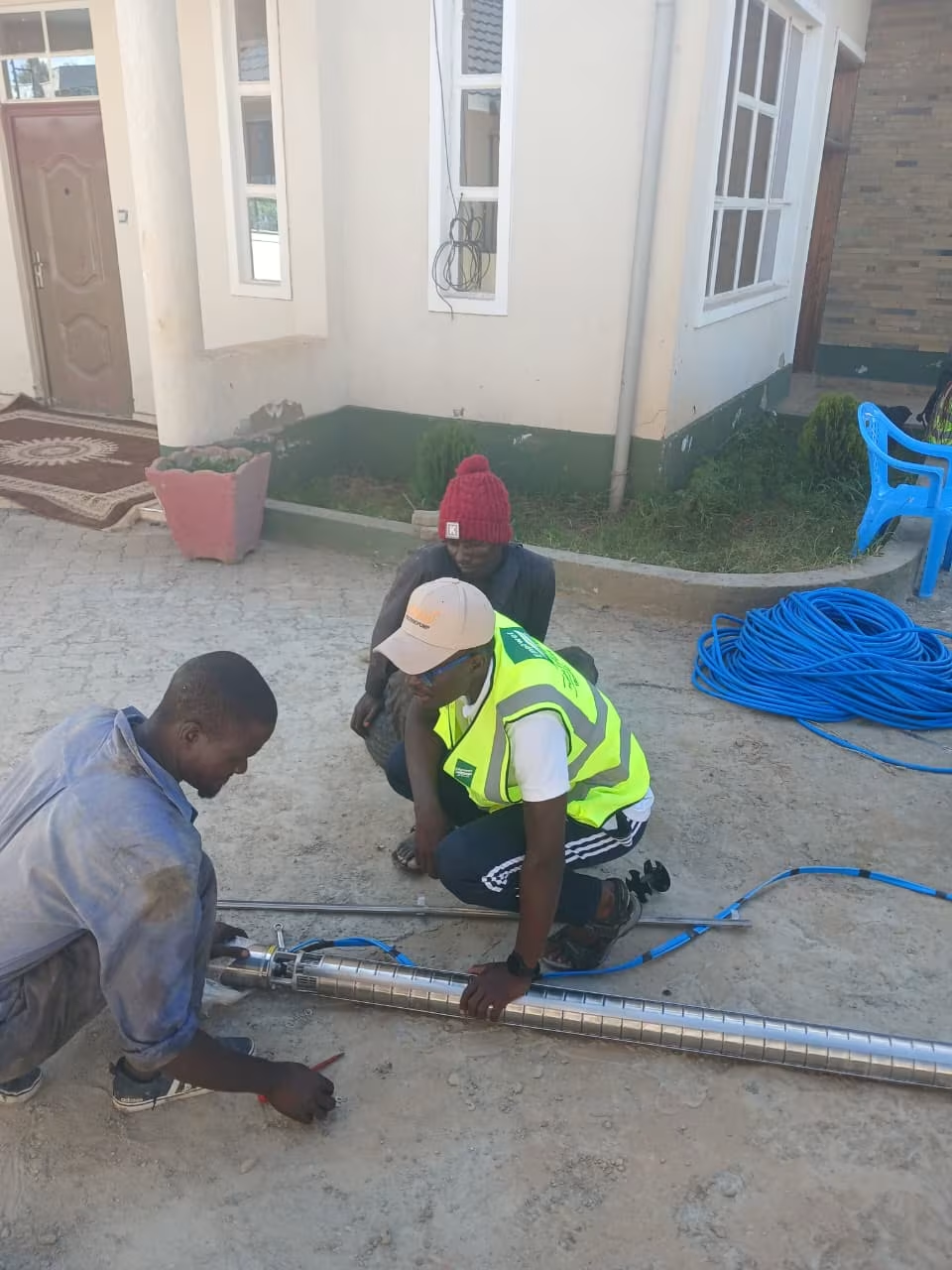
Housing project borehole equipping should follow a phased water-service brief and reliable source evidence. An affordable-housing label does not establish a universal pump size or complete project price. First, define the stages of occupation and shared infrastructure. Then assess the equipment, operating responsibilities and evidence required before residents rely on the supply.
Explore Masterpiece Hydro-Solutions borehole equipping services and enquire about a housing-project equipping assessment. Confirm the proposed scope for your development. Send the current layout, intended occupancy stages and available source records before asking for a final package or service commitment.
Define the occupation stages honestly
Identify occupied units, units ready for occupation and later planned phases separately. Also, describe shared facilities that use water. A final development total may matter for planning, but it does not represent measured current demand. The assessor needs both present evidence and future assumptions.
Next, state the role the borehole should play. It may supplement another source or serve a defined part of the development. Do not assume it supplies every future use unless that is the actual brief. Even then, the requirement remains something to assess rather than a guaranteed outcome.
Also, identify the person who confirms the demand study and project assumptions. The pumping provider should not invent per-resident standards. Appropriate project professionals must establish the service brief and explain how occupancy changes affect the planning decision.
Base housing project borehole equipping on source evidence
Share the relevant test-pumping report and water-level information. Ask the qualified practitioner which abstraction basis those records support. Aquifer yield, pump capacity and resident demand remain different. Installing a larger motor cannot prove that the source supports a larger occupied phase.
Next, identify changes since the available testing. The records may remain useful while requiring interpretation for the current brief. Ask what uncertainty matters for the next commitment and whether further assessment would improve the decision. Do not fill a missing source figure with a desired project target.
Housing project borehole equipping should therefore have an evidence gate before each major capacity commitment. The project can plan future phases while keeping their water-service assumptions conditional on the information still needed. This supports clear decisions without promising groundwater availability.
Assess the complete delivery duty
Provide the proposed storage destinations and relevant route information. Also, identify whether the borehole serves more than one tank. Different elevations and simultaneous destinations can create different duties. The provider needs an actual operating arrangement rather than a broad description of an estate supply.
The Grundfos resource on pump selection explains why flow and head inform selection together. Ask the practitioner to assess pumping lift, delivery elevation, route losses and any required outlet service. Drilled depth alone cannot define the equipment package.
Next, distinguish borehole-to-storage filling from resident distribution. A contractor may accept one boundary without accepting the other. The project should identify who assesses downstream service and coordinates the interfaces before treating a filling demonstration as proof of service throughout the development.
Compare housing project borehole equipping stages
The table below helps a project team match evidence to a decision. It does not prescribe a universal development sequence. Adapt it to the actual professional scopes, contract and current authority requirements.
| Stage | Evidence to review | Commitment to define |
|---|---|---|
| Initial package planning | Source records and current service brief | What can the supplier assess or price now? |
| First occupied phase | Agreed demand and relevant commissioning evidence | Which destinations form part of acceptance? |
| Additional occupied blocks | Revised demand and source review | What needs reassessment before expansion? |
| Operating handover | Asset records, instructions and open items | Who accepts ongoing management? |
| Later equipment change | Updated duty and compatibility assessment | Who approves scope and records the change? |
Next, identify the responsible party at each gate. A clearly assigned review prevents an earlier planning assumption from becoming an automatic promise to later occupants.
Keep the budget tied to complete scope
Ask the quotation to identify assessment, equipment, installation and commissioning. Also, clarify storage, power and distribution interfaces. A pump price alone does not explain the cost of useful water service. The project needs visible exclusions and provisional items before comparing offers.
Next, separate capital work from the responsibilities of ongoing operation. The future manager needs to understand power, monitoring and service arrangements. Do not assume a lower equipment total automatically creates a lower operating burden. Request evidence and clear terms for the options under consideration.
Housing project borehole equipping should avoid unsupported affordability claims. No standard saving or payback follows from the project category. Ask for actual quotations and project-specific assumptions, then keep the comparison within the same service boundary and evidence basis.
Plan storage and reserve for the occupied stage
Describe when residents use water and when the system can replenish storage. A daily volume and a busy-period service requirement are different. Ask the practitioners to connect source production, useful capacity and downstream distribution under the intended operating plan.
Next, identify any reserve the project intends to protect. Nominal tank volume does not automatically equal usable reserve. The qualified provider should explain operating assumptions, while the owner confirms priorities and the arrangement for a prolonged interruption.
Also, distinguish power backup from alternative water. A second power source may address an outage without solving equipment failure or insufficient yield. The proposal should identify the interruption it addresses and the limits that remain.
Assign quality and permission responsibilities
Water clarity and successful pumping do not establish drinking-water suitability. Appropriate laboratory analysis and qualified interpretation for the intended use guide that decision. Ask who arranges the evidence and who decides whether further assessment or treatment scope is needed.
For authority matters, consult the Water Resources Authority’s permitting guidance and confirm current project-specific requirements directly. The equipment quotation does not itself establish permission to abstract a planned volume. Identify the person coordinating relevant submissions and records.
Next, connect those responsibilities to the project programme. A completed equipment installation may still leave another evidence or approval decision open. The handover should identify that boundary rather than quietly assume every project requirement belongs to the installer.
Work through an additional-block scenario
Consider an educational example where the first housing block receives supply from an assessed installation and another block later reaches occupation. No actual development or production result is implied. The original brief did not establish service for every future phase.
First, the project team updates demand and destination information. Next, the practitioners compare the expanded brief with source evidence and existing equipment. They identify any further work or operating change. The owner then makes the next commitment using the revised assessment.
This example shows why housing project borehole equipping needs a phase review. A functioning first-stage system can remain useful without proving spare groundwater or distribution capacity. The next block should receive a defined service basis, not an assumption inherited from early planning.
Prepare the operating handover early
Identify the organisation or team that will manage the installation after project delivery. Also, clarify when it receives records and instruction. The developer’s contractor contacts may not remain the everyday operating arrangement once residents occupy the site.
Next, retain source reports, equipment references and approved changes in one accessible file. The operator needs to understand what the system was assessed to do. A new manager should not have to reconstruct the service boundary from scattered invoices and photographs.
Housing project borehole equipping also needs clear fault-reporting responsibilities. The caretaker should understand normal indications and whom to contact. Qualified personnel must perform electrical changes, equipment retrieval and specialist maintenance. Operating continuity should not depend on improvised technical intervention.
Review housing project borehole equipping acceptance
Agree how the supplier will demonstrate the contracted service at the intended destinations. The record should identify observed delivery, relevant conditions and incomplete checks. Qualified personnel should choose and perform appropriate technical procedures; owners should receive an understandable explanation.
Next, distinguish a commissioning observation from future seasonal production. One demonstration cannot guarantee every later operating day. The provider should explain limitations and useful monitoring records. Also, identify how the parties close any outstanding item.
Finally, request tax treatment, offered warranty terms and variation arrangements in writing. The commercial commitment should match the actual supplied work. Do not assume it includes unlimited future expansion, continuous attendance or guaranteed water regardless of source conditions.
Questions about housing-project equipping
Can the installer price the final development immediately?
Ask what information the provider needs and which assumptions remain provisional. A final plan can support early discussion, but equipment and source decisions need evidence. The proposal should distinguish confirmed scope from later assessments instead of present an unexplained all-in promise.
Does extra motor capacity prove room for another phase?
No. Source capability, pump duty and resident demand are separate. Ask for a review of the expanded requirement before making a supply commitment. The existing equipment may need assessment, but a larger motor alone cannot establish sustainable groundwater availability or adequate downstream service.
Who should manage the installation after completion?
The owner must identify the intended management arrangement and confirm its responsibilities. The supplier should explain the records, instruction and service support included. A caretaker needs clear normal-use and reporting information, while technical tasks remain with qualified personnel under an appropriate scope.
Does a full tank complete the water-project handover?
Not automatically. Check the contract boundary, resident distribution requirements and other relevant evidence. Quality, source performance and equipment operation answer different questions. The final pack should identify what the contractor demonstrated and which remaining decisions belong elsewhere in the project.
Enquire with the occupation stages and source records
Prepare the current layout, phased demand brief and available borehole evidence. Then enquire about a housing equipping assessment with Masterpiece Hydro-Solutions. Confirm the site-specific service scope. Ask for clear interfaces, realistic assumptions and an operating handover that remains useful beyond construction.