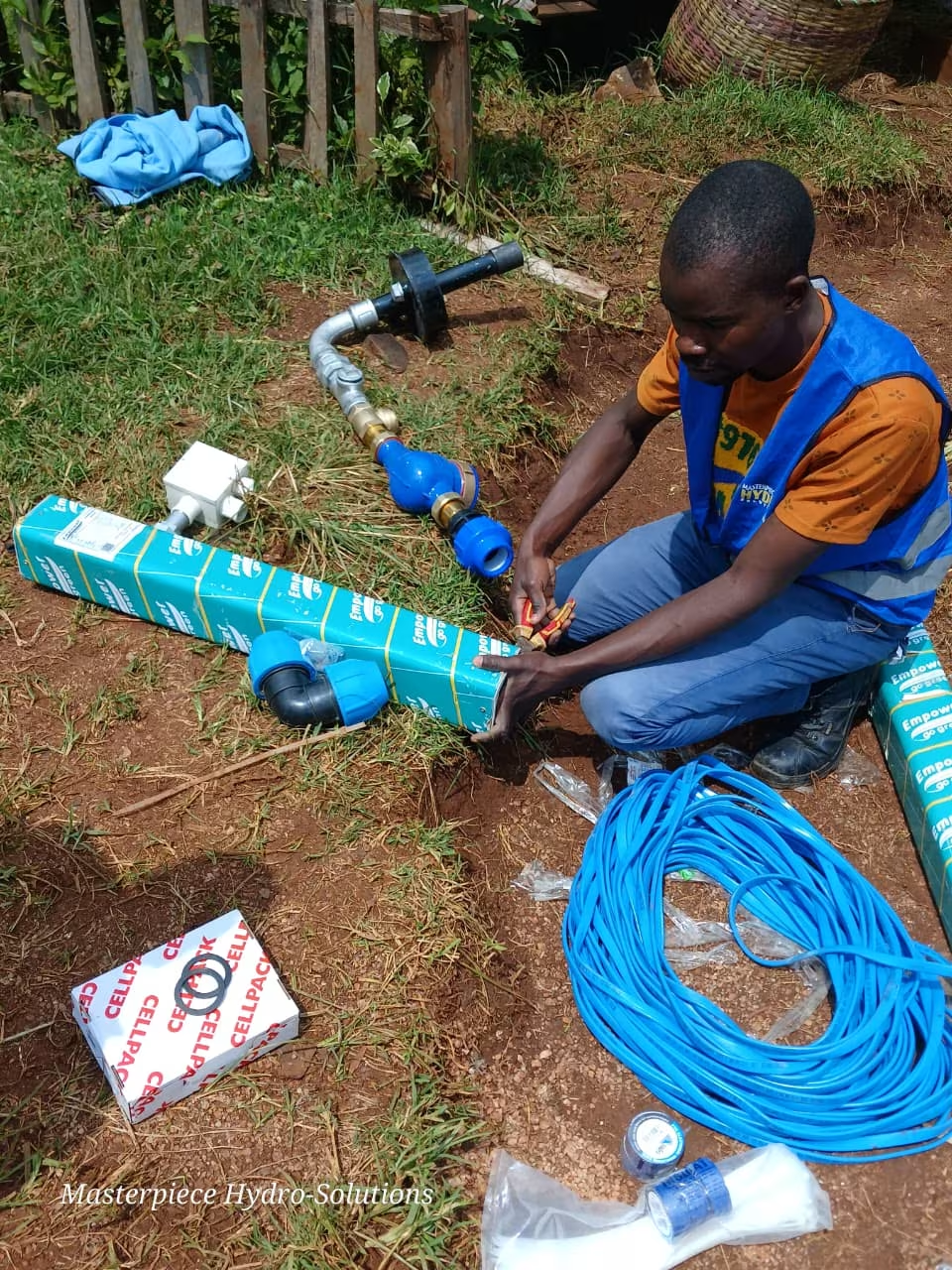
Pump sizing from test results connects source observations with the water service the owner needs. A test-pumping report does not automatically identify the final pump model. First, understand the measured rates, water levels and conditions. Then ask the assessor to combine that evidence with demand, delivery head and available power before confirming equipment.
Explore Masterpiece Hydro-Solutions borehole equipping and request a test-record-based equipment assessment. This guide helps buyers prepare and question a sizing brief. It does not interpret a particular test, prescribe an abstraction rate or provide a site design from hypothetical figures.
Organise pump sizing from test results around original records
Provide the full test report rather than only a remembered flow figure. Also, include the borehole completion record and any relevant later observations. Confirm that documents identify the same source. A summary may help initial discussion, but the responsible assessor should explain what evidence they need before selecting equipment.
Next, identify the report date and stated conditions. Test evidence describes observations from a particular exercise; it does not establish that every later operating condition matches them. Tell the assessor about changed demand, interruptions or source concerns since the test. Those facts may affect the relevance of older measurements.
Separate measured rates from the recommended operating plan
A report may contain several observations at different times or operating rates. Ask the professional to identify which evidence supports the proposed abstraction arrangement. Do not simply choose the largest number appearing in the file. A measured rate has context, and the owner needs to understand the reasoning behind the eventual operating recommendation.
Pump sizing from test results should keep available source supply, pump capacity and user demand distinct. The test does not turn desired demand into confirmed groundwater. Likewise, a pump’s catalogue capacity cannot justify abstraction that the source assessment does not support. Any shortfall needs an explicit project decision before ordering equipment.
Keep each depth and water-level term clear
Drilled depth describes the completed hole. Static water level concerns water at rest under stated conditions, while pumping water level concerns its position during abstraction. Pump setting depth identifies the equipment’s installed position. These terms should not replace one another in the sizing conversation, even when several values appear as depths.
Ask for consistent units and measurement references. Also, identify which rate and observation correspond to a quoted pumping water level. A copied figure without its context can confuse the delivery calculation. The assessor should explain the relevant basis in language the owner can follow without pretending the owner must independently certify the technical interpretation.
Use a report-to-design evidence table
The table helps the owner connect supplied records with unanswered selection questions. It does not prescribe how a qualified professional should analyse a test. First, identify available evidence. Then ask how each item informs the proposed equipment and which missing facts require further assessment.
| Record or input | Question for the assessor | Selection relevance |
|---|---|---|
| Test identity and date | Does this evidence concern the correct source and period? | Establishes which observations the proposal relies on |
| Recorded pumping rate | Which conditions accompany the figure? | Supports assessment of the proposed operating arrangement |
| Measured water levels | Which reference and rate apply? | Informs the pumping-lift basis |
| Owner demand | Is it measured, estimated or a future scenario? | Defines the service requirement rather than source capacity |
| Tank and delivery route | What destination and losses need assessment? | Completes the required delivery head |
| Available power | Who verifies suitability for the proposed combination? | Supports compatible motor and control selection |
Complete pump sizing from test results with the destination
The source report does not describe every part of the delivery route. Provide the intended storage destination, elevation information and known route details. Also, state any required outlet service. The assessor should establish total dynamic head using pumping lift, delivery elevation, pipe losses and required pressure as relevant.
Required flow and head need consideration together. The Grundfos pump-selection resource explains their relationship. A test rate cannot become a complete pump recommendation until the designer assesses the actual duty and suitable equipment arrangement. The storage destination matters even when the borehole itself remains unchanged.
Use an illustrative head calculation carefully
Consider an educational example that assumes a pumping lift of 65 metres from a consistent reference. Assume delivery adds 15 metres of elevation and the assessed route adds ten metres of losses. Assume no additional outlet-pressure requirement. The assumed total dynamic head becomes 90 metres. These values demonstrate categories, not a design for any real site.
The example does not use total drilled depth as the pumping lift. It also does not identify pump setting depth or a suitable model. Actual losses and required pressure need professional assessment. Therefore, ask the designer to explain the site’s own head basis instead of copying these arbitrary assumptions into a quotation request.
Pump sizing from test results becomes clearer when the owner can see which values come from observations and which come from the delivery assessment. Keep those inputs traceable. If the project changes the tank position later, ask whether the head and equipment selection need revision before assuming original performance will continue.
Check daily volume without overreading the test
Use another educational assumption: the owner needs 15 cubic metres daily, equivalent to 15,000 litres. If an assessed operating arrangement averages 2.5 cubic metres per hour, producing that amount requires six operating hours. This arithmetic connects an assumed rate and demand; it does not establish a sustainable rate or available operating window.
Now assume the proposed daily operating opportunity only supports four hours at that average. The corresponding volume becomes ten cubic metres, leaving five cubic metres unmet. Storage may bridge a temporary gap, but it cannot cover a permanent deficit. The project needs a response to the balance rather than a larger catalogue rating.
Explain how equipment selection follows the assessed duty
Ask the provider to identify the proposed duty and explain the selected pump against it. Also, request exact equipment identities and the compatibility basis for motor and controls. The buyer does not need to reconstruct manufacturer curves. They need an accountable explanation connecting source evidence, delivery requirements and the proposed combination.
Pump sizing from test results should leave important assumptions visible. For example, a destination measured provisionally may need confirmation before the order becomes final. An early model allowance can help budgeting, but it should remain conditional when necessary inputs are missing. Avoid converting a preliminary conversation into an unsupported equipment commitment.
Identify when current assessment is necessary
Tell the assessor about long gaps since testing, reduced delivery or significant site changes. Ask whether the records remain adequate and what further work could resolve a specific uncertainty. There is no universal age limit in this guide. The professional should explain the relevance of the evidence to the present decision.
If source condition needs investigation, discuss borehole inspection as a separate assessment option. Do not assume inspection replaces test interpretation or guarantees increased supply. Each task should answer an identified question, with its purpose and limitations clear before the owner approves additional work.
Review pump sizing from test results before acceptance
Keep the agreed sizing basis with the installation scope. At commissioning, request measured delivery, relevant water-level information and operating conditions at the stated destination. Next, compare observations with the design assumptions. The team should explain differences and identify whether further assessment or corrective work remains necessary.
Also, ask qualified personnel to demonstrate normal controls and protection behaviour. Owners should not alter settings or bypass controls to obtain a preferred flow. The commissioning record provides a useful baseline, while ongoing operation may need further observations. One demonstration cannot prove every future source or demand condition.
Questions owners ask when reading a test report
Can we buy a pump from the highest tested rate?
Ask the qualified assessor which evidence supports the proposed operating arrangement. The largest number alone is insufficient. Also, provide the actual destination and demand. Pump sizing from test results needs source interpretation and a complete duty assessment before equipment confirmation.
Does total drilled depth equal required head?
No. Pumping lift relates to the assessed operating water level, while total dynamic head also includes delivery requirements. Drilled depth and setting depth serve different purposes. Ask the designer to identify the measurement references and explain how the actual duty calculation uses them.
Can a larger pump guarantee the required daily volume?
No. The source must support the proposed abstraction, and operating opportunities must support the volume. A larger unit cannot create groundwater. Also, any selected pump needs to suit the assessed head and complete arrangement rather than only a desired daily total.
Do clear test samples prove drinking-water suitability?
Appearance cannot establish potability. Arrange appropriate laboratory analysis and advice for intended use. Water quality and pumping performance answer different questions. The equipment assessment should identify that boundary rather than imply that a favourable flow observation makes every use suitable.
What should we send for a sizing enquiry?
Provide the full test report, completion record, daily demand and tank information. Include available power details and any changes since testing. Finally, mark unknowns clearly. This helps the provider identify missing assessment before proposing a final duty and equipment selection.
Request a traceable duty brief
Link source observations, water requirement and delivery route in one assessment file. Ask the provider to identify assumptions, selected duty and remaining uncertainty. Finally, retain commissioning records beside that basis. These steps make pump sizing from test results useful throughout the equipment project’s life.
Request a test-record-based equipping assessment from Masterpiece Hydro-Solutions. Send the original evidence and explain the destination before choosing a model. A useful proposal shows how the professional moved from recorded observations to an assessed equipment arrangement, without promising unverified water availability.