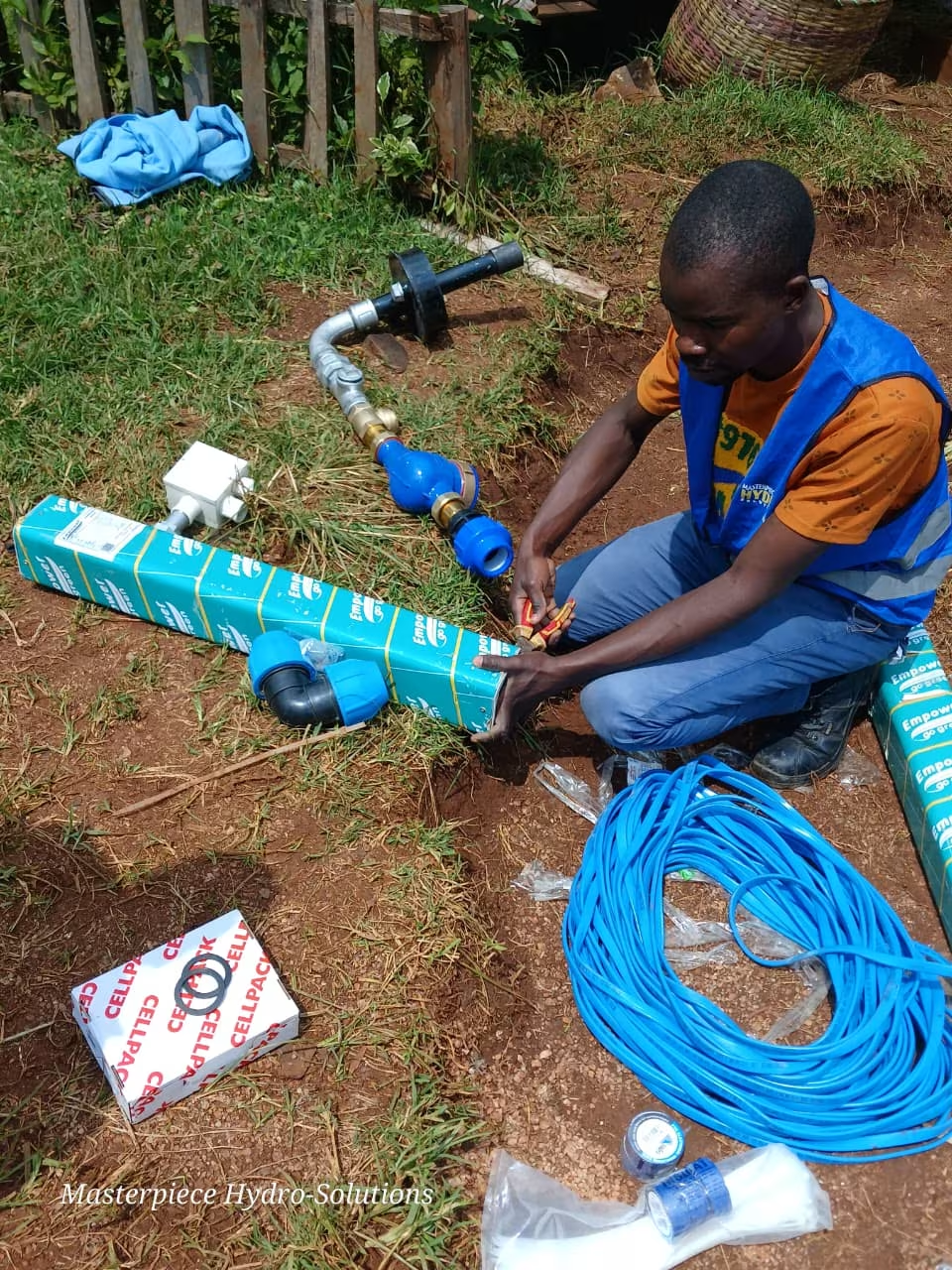
Submersible borehole pump installation needs a readiness check before equipment arrives and an acceptance plan before work starts. The owner should know the selected duty, source evidence and delivery destination. First, resolve important unknowns. Then agree the records and qualified responsibilities that will connect the installed equipment with the water service you expect.
Explore Masterpiece Hydro-Solutions borehole equipping and request an installation assessment. This guide concerns buyer preparation and acceptance. It provides no lifting, wiring or mechanical installation instructions; qualified personnel should plan and carry out those technical tasks for the assessed site.
Confirm readiness for submersible borehole pump installation
Ask whether the source records and necessary measurements support final equipment selection. The completion report and test-pumping evidence should identify the correct borehole. Also, tell the assessor about work or changes since those records. An early recommendation may need clarification if the actual tank destination or intended use has changed.
Next, list unresolved items that could alter the selection or work scope. Examples include missing operating water-level information or uncertain power arrangements. Give each issue a responsible person and a next action. This avoids treating the installation date as a reason to proceed with an important assumption nobody has checked.
Agree the selected duty rather than a pump label
Request the required flow and total dynamic head for the actual destination. The Grundfos pump-selection resource explains why these belong together. A maximum catalogue flow or motor rating alone cannot describe the service the installed unit will provide at your assessed duty.
Also, distinguish drilled depth, pump setting depth and pumping water level. Total dynamic head considers pumping lift, destination elevation, pipe losses and required outlet pressure. Ask the designer to explain the measurement basis. Owners need a clear duty statement, not an unsupported assumption that equipment suitable for a similar depth must suit their borehole.
Check submersible borehole pump installation equipment identities
Before accepting delivered equipment, compare its identities with the approved schedule. Ask the responsible contractor to explain any proposed substitute and its suitability. Also, retain readable model and serial references where supplied. This is an owner-level record check; it does not require the owner to inspect internal parts or certify technical compatibility.
Agree how the project approves substitutions. A different model can affect more than price, so the explanation should address the selected duty and complete arrangement. Do not let a verbal claim of equivalent power replace a documented assessment. The installation file should make clear what the team actually supplied.
Use practical readiness checkpoints
The following checkpoints help the owner coordinate decisions with qualified personnel. They do not prescribe installation methods. Ask the contractor which checkpoints apply to your project and when they need a response. Also, identify any item that remains outside the quoted work so another responsible party can arrange it.
| Checkpoint | Evidence for the owner | Decision before proceeding |
|---|---|---|
| Source readiness | Relevant completion and test records | Does equipment selection have an adequate basis? |
| Equipment delivery | Approved model schedule and supplied identities | Has the contractor justified any substitution? |
| Supply and controls | Qualified assessment and defined responsibility | Who confirms the arrangement is suitable? |
| Site access | Agreed entry and working area | Can the team carry out its assessed work? |
| Commissioning | Measured delivery and operating observations | How do results compare with the agreed basis? |
| Operator handover | Normal indicators and support contacts | Can the operator recognise and report a change? |
Coordinate the work area and future access
Tell the contractor about gates, active site uses and any known restrictions. The qualified team should assess its equipment-handling requirements and technical work area. Also, nominate a site contact who can coordinate entry and resolve practical questions. Owners should keep other users away from the agreed work area rather than attempt to assist with technical handling.
Consider future maintenance access as well as today’s delivery. New walls, tanks or buildings may affect how a later team reaches the installation. Submersible borehole pump installation planning should identify those foreseeable changes early. A practical access decision can prevent the completed property from making ordinary equipment assessment unnecessarily difficult.
Assign electrical and control responsibility clearly
Ask who assesses the available supply, specifies compatible controls and performs the electrical work. The responsible qualified people should explain their scope and relevant current credentials. Also, make the interface with any separate electrical contractor explicit. An installation quote should not leave each team assuming the other will confirm compatibility.
Describe the desired operating behaviour in ordinary terms. For example, explain the storage destination and ask how the system responds to tank level or insufficient source water. The contractor should design and demonstrate suitable controls. The owner needs to recognise normal indicators and fault reporting, without changing wiring or bypassing protection.
Work through an illustrative acceptance brief
Consider an educational requirement of 12 cubic metres daily, or 12,000 litres, delivered to one assessed tank destination. Assume a measured average flow of three cubic metres per hour during a stated operating period. Producing the assumed daily volume would require four operating hours. These figures illustrate arithmetic, not source capacity or a recommended installation.
The commissioning record should identify the destination and conditions behind the measured flow. If the owner later moves the destination or changes the route, the original observation does not automatically establish the new performance. Therefore, record the installation basis and notify the assessor about relevant changes.
Submersible borehole pump installation acceptance should also address the source limit. A flow observation alone cannot guarantee sustainable daily abstraction under every condition. Ask what the test and commissioning evidence support, what uncertainty remains and which operating records the owner should maintain after the team leaves.
Manage differences found during the work
Agree a process for unexpected findings before installation begins. The contractor should explain the issue, proposed response and effect on scope. Also, identify the authorised person who approves a justified variation. This keeps commercial decisions traceable while leaving technical methods with the qualified team.
If source condition needs investigation, discuss borehole inspection as an assessment option. Do not turn an observation into a guessed diagnosis or an automatic rehabilitation order. The next task should follow the evidence, with any remaining uncertainty clear to the owner.
Accept submersible borehole pump installation with measured records
Request equipment identities, measured delivery, relevant water-level information and operating conditions in the handover record. Next, compare these with the agreed duty basis. Ask the team to explain any difference rather than simply note that water flows. Record outstanding actions and who will provide the necessary clarification.
Also, ask for demonstrations of the agreed control behaviour and an explanation of protection indicators. Qualified personnel should conduct testing. The owner needs to understand normal operation and the support route. A successful demonstration becomes more useful when the written record makes clear what the team observed and what it did not establish.
Keep quality and operating limits visible
A newly installed pump does not establish water quality. Arrange appropriate laboratory analysis and advice for the intended use. Clear appearance cannot prove suitability for drinking. Also, keep available source supply separate from installed equipment capacity. A more capable pump cannot remove a continuing gap between sustainable production and demand.
Nominate an operator and a backup contact. Keep manuals, warranty terms and commissioning evidence in a shared project file. Submersible borehole pump installation should finish with understandable responsibilities, not only a completed invoice. Later changes in demand, storage or supply arrangements should prompt discussion with the relevant qualified assessor.
Questions owners ask before installation day
Should all equipment arrive before the final assessment?
Ask which information the contractor needs before confirming the equipment order. Important unresolved source or duty questions may affect selection. An early equipment allowance should remain visibly provisional. The project should not use delivery timing to justify installing a model whose suitability nobody has confirmed.
Can a different model replace the quoted one?
Potentially, after the responsible professional explains the substitute against the required duty and compatibility. Record approval and supplied identities. Also, clarify any changed warranty or support terms. Matching a power rating alone does not establish that two models provide equivalent service at your site.
Can we verify installation quality by watching the team?
Owners can check agreed records, identities and responsibilities, but observation does not replace qualified technical assessment. Stay outside the work area and use the agreed site contact. Submersible borehole pump installation needs evidence and accountable commissioning rather than an owner’s attempt to supervise specialist methods.
What if the tank fills more slowly than expected?
Compare the observation with the agreed conditions and report the difference. Source behaviour, duty, controls or changed demand may need assessment. Avoid changing settings or assuming one cause. The commissioning baseline helps the qualified team investigate a factual performance concern.
What belongs in the handover file?
Keep the selected duty, equipment identities, commissioning observations and operating instructions. Add warranty terms, support contacts and unresolved action records. Also, retain the source evidence used for selection. This gives later operators a useful reference when conditions or equipment change.
Request an installation scope you can accept
Bring source records, demand and destination details into one readiness discussion. Agree supplied identities, qualified responsibilities and measurable acceptance evidence. Finally, preserve the handover file. These steps make submersible borehole pump installation a defined project rather than a purchase judged only by the first flow.
Request a site-specific installation assessment from Masterpiece Hydro-Solutions. Ask which evidence remains necessary before selection and what the contractor will document at acceptance. A clear proposal helps the owner understand the equipment arrangement and its operating limits.