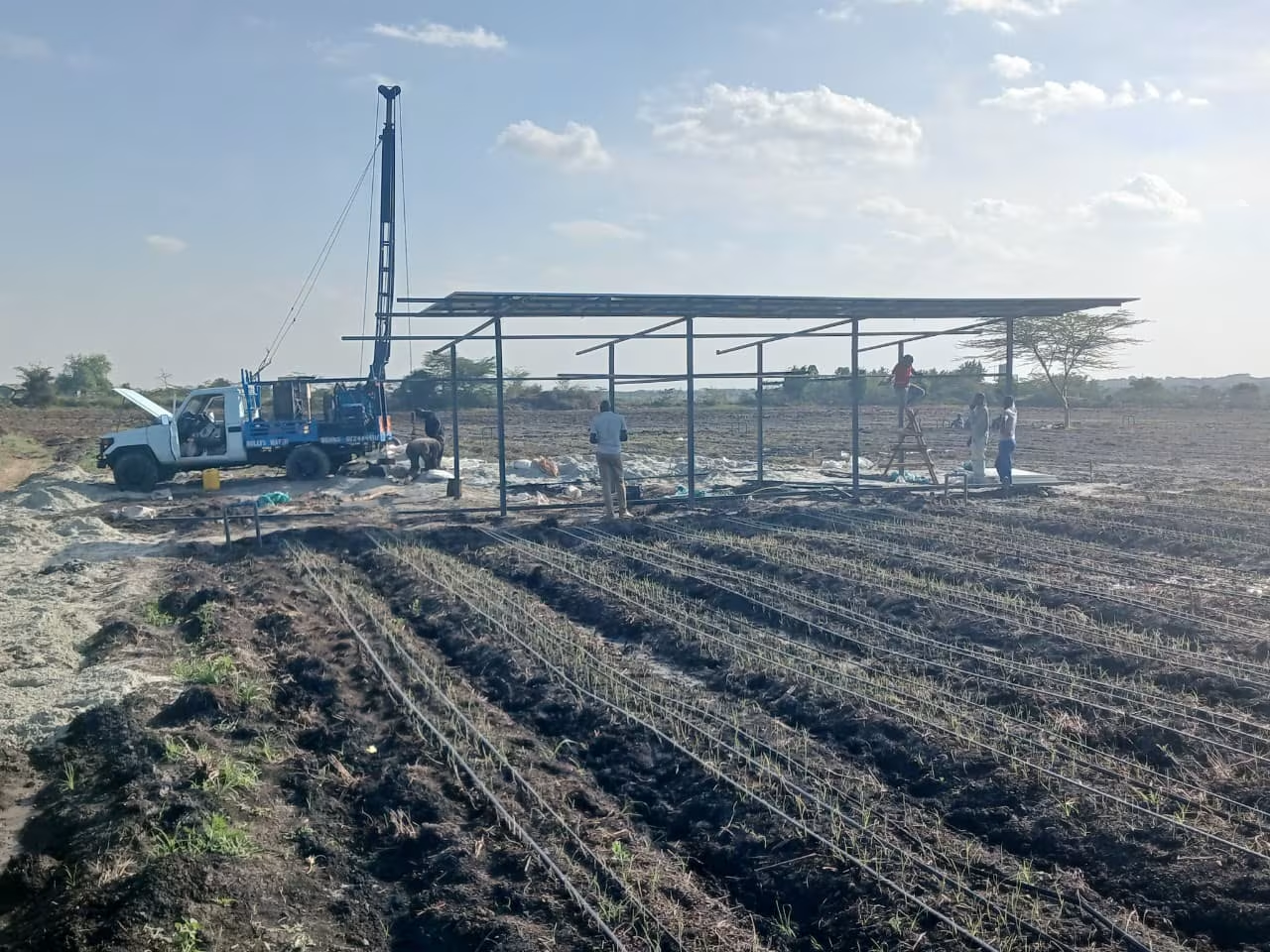
Solar pump tank storage works best when the filling plan matches the timing of water use. A tank provides useful reserve only when its operating levels, delivery route and refill pattern are understood. Therefore, define how the stored water will serve the site before choosing capacity or accepting an installation package.
This guide focuses on planning and operating the connection between a solar borehole and storage. For the pumping service, see Masterpiece Hydro-Solutions borehole solarisation. You can also request a pumping and tank assessment with the records and layout details already available.
Define the role of each tank
First, explain what the storage is supposed to achieve. It may hold daytime production for evening use, provide a reserve for essential users or support a planned watering schedule. These purposes can coexist, but the owner must decide their priorities. Otherwise, routine use may consume a reserve that everyone assumed remained protected.
Next, identify the tank’s connection to the rest of the water supply. Does it feed users directly, supply another tank or require a separate distribution pump? The water delivered into storage and the water available at an outlet are different operating questions.
Also, label existing and proposed tanks clearly on a simple site sketch. Record each tank’s known capacity, location and function. A clear layout helps the contractor identify which measurements and connection details need confirmation.
Match solar pump tank storage to the demand pattern
Daily use and the timing of use belong together. Record morning, daytime and evening demand where existing meters or logs allow. Also, identify activities that can move to another period. A flexible farm schedule may allow a different operating plan from a continuously occupied residential property.
Do not use nominal tank capacity as a substitute for measured demand. The same tank may refill several times, once or less often during a day. Therefore, ask how the assessment will estimate actual consumption and which figures remain uncertain.
Separate the current requirement from future expansion. If more users or another production area may join the supply, ask for a separate scenario. This keeps the initial storage obligation clear while allowing informed planning for later changes.
Understand nominal, useful and reserve volume
The tank’s labelled volume does not necessarily equal the amount available for ordinary use. Actual operating levels, outlet arrangement and the reserve policy can affect useful capacity. Ask the designer to explain those boundaries using the proposed installation rather than a generic assumption.
For example, an owner may decide that a portion of useful storage remains for essential demand. That is an operating policy, not proof that the reserve will always be available. The refill plan must still support it, and the operator needs a clear response when the reserve declines.
Also, distinguish an alarm level from the point at which the tank is effectively empty for its intended use. These levels should have documented meanings so that different operators respond consistently.
Check production before relying on reserve water
Solar pump tank storage cannot create additional groundwater or remove a continuing supply deficit. First, establish what the source can support under assessed conditions. Next, compare expected daily production with demand and the need to replenish any reserve already used.
Keep borehole yield, pump capacity and daily consumption separate. A high-capacity pump can exceed what a source sustainably supports. Similarly, a large tank may take too long to refill under the proposed operating arrangement. The assessment should explain these relationships before installation.
Ask the contractor which test-pumping records and water-level measurements inform the proposal. If those records are missing, identify the evidence gap. Do not turn an unverified estimate into a guaranteed filling schedule.
Use an illustrative daily water balance
Consider an educational example with assumed daily use of 12 cubic metres. Suppose the site begins a day with 8 cubic metres of useful stored water and receives another 10 cubic metres from pumping. Ignoring losses for this simple illustration, the closing storage would be 6 cubic metres: 8 plus 10 minus 12.
The tank still contains water, but the reserve has declined by 2 cubic metres. If the pattern repeats, the deficit continues. Therefore, ask how the operating plan will restore storage rather than treating the absence of an empty tank as proof of balance.
Real assessments should also consider overflows, leaks, meter uncertainty and relevant operating conditions. These assumed figures are not a tank-size recommendation, a source-yield claim or a promise about local solar production.
Agree filling priorities and operator responses
Where several tanks or users share a source, decide the filling priorities in advance. Essential domestic supply, irrigation and a process tank may need different treatment during a shortfall. Ask the designer to explain how the proposed arrangement implements the agreed priorities.
| Operating situation | Decision to agree | Record to keep |
|---|---|---|
| Storage reaches normal high level | How filling stops or moves to another agreed destination | Observed level and control behaviour |
| Reserve falls below the agreed warning point | Who reviews demand and the refill plan | Time, level and response |
| One tank fills while another remains low | How priorities and possible faults are assessed | Tank identities and relevant readings |
| Unexpected overflow occurs | Who reports and investigates the condition | Safe observations and contractor findings |
| Pumping stops for planned work | How essential demand and reserve are protected | Agreed outage plan and responsible contacts |
Review elevation and the delivery route
Tank location affects the pump’s required duty. The assessment should consider pumping water level, delivery elevation, pipe friction and any required pressure at the delivery point. Drilled depth alone does not establish the head the pump must overcome.
Grundfos’s pump-selection guidance explains why flow and head belong together. Apply that principle when comparing a nearby low tank with a more distant or elevated destination. The same pump model may not provide the same delivery in both situations.
Also, arrange qualified assessment of structures and installation requirements where storage is elevated or altered. A larger tank should not be proposed without considering the suitability of its support and connections.
Check level controls and protection evidence
Ask how the installation detects a full tank and responds to low-water conditions at the source. The control explanation should identify the actual equipment and intended behaviour. Also, clarify which faults the operator can observe safely and when qualified support is required.
Solar pump tank storage needs practical commissioning evidence, not just a statement that sensors are included. Ask the installer to demonstrate agreed control functions and record limitations. Owner guidance should distinguish authorised routine operation from electrical settings or repairs reserved for competent personnel.
For relevant practitioner information, consult EPRA’s renewable energy information and registers. Do not bypass protection or improvise electrical connections when a tank fails to fill as expected.
Keep a simple storage and production log
Use a consistent observation time and clear units. A useful log can include source meter readings, tank level, known unusual demand and visible faults. Also, record changes to normal operation, such as a tank cleaning visit or a distribution repair.
The purpose is to make changes visible. For example, falling storage alongside normal measured production may suggest a different question from falling production itself. However, observations alone do not establish the cause. Share the record with a qualified contractor for interpretation.
Avoid presenting an estimated tank level as an exact measured volume unless the method supports it. Good records distinguish readings, estimates and assumptions, making later comparisons more reliable.
Include quality, upkeep and water-use questions
Storage introduces responsibilities for condition checks, access and maintenance planning. Ask who will report leaks, damaged covers or unusual conditions. Also, clarify which professional support is available for cleaning, repair or return-to-service decisions.
Stored water is not automatically suitable for drinking. Clear appearance, solar power and a new tank do not establish quality. Arrange appropriate laboratory evidence and professional interpretation for the intended use where relevant.
Keep water-use requirements separate from equipment delivery. WRA’s permitting guidance describes authorisation and water permit processes. Ask the authority to confirm current site-specific requirements rather than assuming a storage change settles every abstraction question.
Define the installation and handover scope
A solar pump tank storage proposal should identify the delivery point, connection works, controls and tests included. Also, list excluded distribution work, structural assessment or tank alterations. Borehole equipping services may involve associated tasks that need explicit inclusion.
At handover, request equipment identities, available as-built information, test records and operator guidance. Match tank labels and control descriptions to the actual site. Next, list outstanding items with a responsible person and a clear completion condition.
Confirm warranty boundaries and the first contact for a fault. A problem involving both pumping and storage should have a clear investigation route rather than leaving the owner to resolve unclear supplier responsibilities.
Frequently asked storage questions
Should I choose the largest tank I can afford?
Choose useful capacity through an assessed demand and refill plan. A larger tank can add reserve, but it does not increase source production or automatically provide the required delivery pressure. Compare complete installation and ownership requirements before selecting capacity.
Can storage supply water after sunset?
Suitable stored water may meet demand outside pumping periods, subject to usable volume and the delivery arrangement. Ask how water reaches the final users and how the reserve will refill. Storing water differs from running the borehole pump at night.
What if the tank never reaches its normal high level?
Record production, demand and relevant operating observations. The cause could involve the water balance, delivery route, controls or another condition. Request a qualified assessment rather than assuming that larger panels or a new tank will resolve it.
How should several users share reserve water?
Agree priorities, responsibilities and warning responses before a shortfall. The installation should support that operating policy. Keep the decisions accessible to caretakers and other authorised operators so that routine demand does not unintentionally consume an essential reserve.
What starts a useful assessment?
Send the county, intended use, existing tank layout and available demand records. Also, include pump and test-pumping information where available. Label unknown capacity, levels or measurements so that the contractor can explain which checks are needed next.
Request an operating plan for the whole supply
A sound solar pump tank storage arrangement connects source evidence, daily demand and usable reserve. First, define tank roles and priorities. Next, assess production and the delivery route. Finally, agree control tests, operator records and support responsibilities.
Discuss your pumping and storage project with Masterpiece Hydro-Solutions. Share the layout and the supply problem you want to solve. The next step is a site-specific plan with understandable assumptions and acceptance conditions.