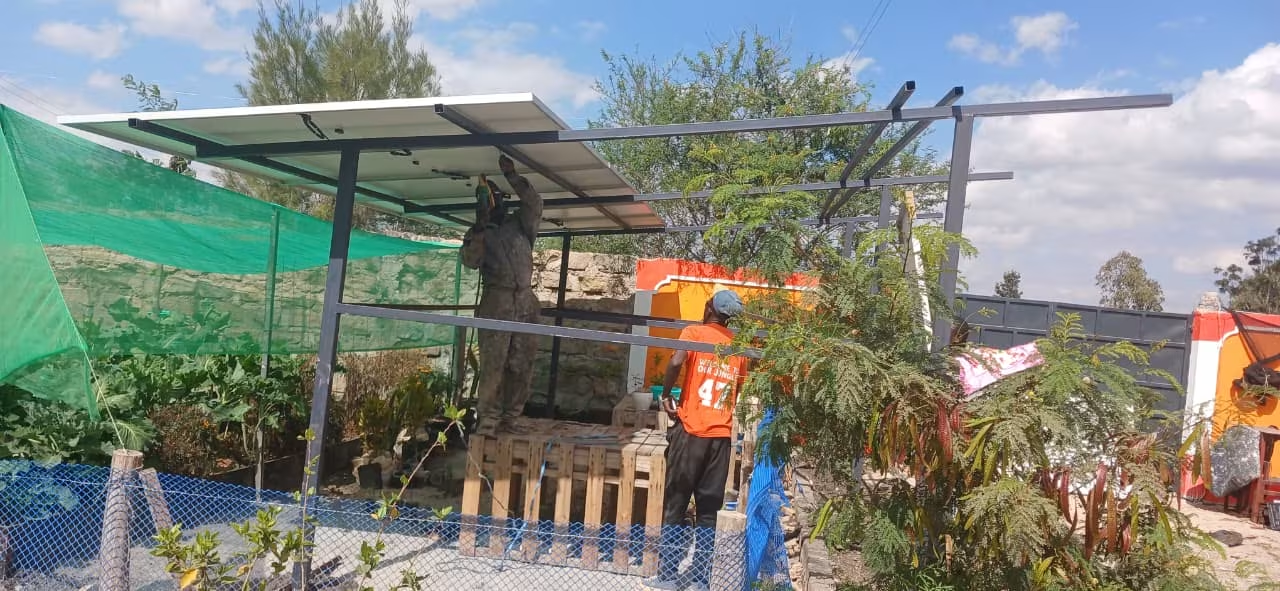
Solar pumping without batteries uses available solar power to move water when conditions and system controls allow. A suitable tank can then hold water for later use. However, this arrangement needs a clear daily supply and storage plan. Removing batteries does not automatically establish reliable water delivery for every borehole or user.
This guide explains the operating questions to assess before choosing a battery-free arrangement in Kenya. See Masterpiece Hydro-Solutions borehole solarisation or request a solar pumping and storage assessment. Describe when you use water and what storage already exists.
Understand what replaces the battery’s role
First, separate storing electricity from storing pumped water. An electrical battery can support an appropriate electrical operating arrangement. A water tank stores water that the pumping system has already delivered. These are different functions, so the design must explain which one the site actually needs.
For example, users may need water after sunset without needing the borehole pump to run at that time. Daytime pumping into suitable storage may address that requirement. However, a site that requires active pumping at night has a different operating brief. The contractor should examine that need explicitly.
Also, identify the final delivery method from storage. Water in a ground-level tank may still need an assessed distribution arrangement. Do not assume that having reserve water automatically provides the required pressure at every outlet.
Match solar pumping without batteries to demand timing
Describe daily water volume and the periods when people use it. A school, apartment building or farm may have different peak periods. Also, distinguish essential demand from use that can move to another time. This helps the designer compare pumping opportunities with actual consumption.
Next, explain how the current supply operates. Does the tank regularly empty overnight? Does the pump run for long periods to catch up? These observations can reveal questions about demand, storage or source production. A new power arrangement should not conceal an existing imbalance.
If demand figures are estimates, label them. The assessment should state its assumptions and explain which measurements would improve confidence. Selecting a package from an estimated user count alone may leave the operating requirement unclear.
Check sustainable production before adding storage
The borehole must support the proposed abstraction under assessed conditions. A larger array and a larger tank do not create more groundwater. Therefore, request relevant test-pumping information and ask how the design respects the source’s limits.
Keep aquifer yield, pump capacity and user demand separate. Also, distinguish drilled depth from pumping water level and pump setting depth. These measurements serve different purposes. The designer should explain the required flow and total head, rather than relying on the motor rating alone.
Grundfos’s pump-selection guidance explains why flow and head belong together. Use that principle when reviewing how the proposed equipment serves the tank location and delivery route.
Separate daily volume from peak flow
Solar production varies through the day and with operating conditions. A pump’s maximum flow does not establish the daily water volume. Ask the contractor to explain its daily-production assumptions and the information used to assess them. Those assumptions should remain distinct from measured commissioning results.
For example, multiplying a peak rate by a long fixed period can overstate supply if the system does not maintain that rate. Instead, request an assessment that addresses the changing operating pattern. Also, ask which design conditions matter for the intended level of reliability.
Solar pumping without batteries depends on the relationship between variable production and water storage. The useful comparison is water available when needed, rather than a panel count or a single brief flow demonstration.
Use a transparent storage example
Consider an educational example with assumed daily use of 10 cubic metres. Suppose 6 cubic metres is needed outside the main pumping period. A storage assessment must address that timing requirement, while also considering reserve policy and useful capacity. The figures do not establish a universal tank size.
Now suppose one day’s pumping produces only 7 cubic metres against the assumed 10 cubic metre demand. The shortfall is 3 cubic metres. An available reserve may cover the gap temporarily. However, repeated shortfalls can empty that reserve unless production later exceeds use or the supply plan changes.
Also, account for usable rather than nominal volume. The designer should explain the actual operating levels and any reserve that the owner intends to protect. Storage calculations need those boundaries to remain meaningful.
Compare the operating choices
Ask for a comparison that starts with the required result. Solar pumping without batteries may suit some demand patterns, while other sites need a different assessed arrangement. Avoid treating any option as universally cheaper or more reliable before comparing complete scope and operating assumptions.
| Arrangement to assess | Main planning question | Limit to examine |
|---|---|---|
| Daytime pumping into storage | Can useful storage serve demand outside pumping periods? | Production variability and reserve recovery |
| Storage with compatible backup | What shortfall or interruption should backup address? | Power-source availability and equipment compatibility |
| Battery-supported operation | Is electrical operation outside solar periods part of the brief? | Complete design, ownership and replacement requirements |
| Adjusted demand schedule | Which uses can move without disrupting essential supply? | Practical operating constraints and user agreement |
The comparison should explain remaining risks and the evidence behind each option. A package label alone does not define the supply outcome.
Assess tank location and delivery pressure
Storage location affects both pumping duty and downstream supply. First, identify the elevation and route from the borehole to the tank. Next, describe where water must go after storage and any pressure requirement at the final use point. These are related but separate hydraulic questions.
Do not assume an elevated tank is automatically suitable or that its support structure can accommodate a proposed change. Qualified personnel should assess relevant structural and installation requirements. The owner needs a clear scope and evidence, rather than a generic construction suggestion.
For associated equipment and delivery questions, review Masterpiece Hydro-Solutions borehole equipping. Confirm which tank connections, distribution works and controls form part of the solar proposal.
Ask how the controls protect the supply
A battery-free arrangement still needs suitable protection and operating control. Ask how the system responds when the tank is full, water availability falls or solar input changes. The explanation should match the actual pump, controller and sensor arrangement.
Also, clarify normal restart behaviour. A pause under weak input may differ from a recurring fault that needs attention. The operator should know which observations are useful and when to contact qualified support. However, owner guidance should not encourage bypassing protection or altering electrical settings.
Qualified personnel must design and test electrical work. For relevant competence information, consult EPRA’s renewable energy information and practitioner registers. Verify current credentials and the scope of the proposed installation.
Plan for cloudy periods and interruptions
Solar pumping without batteries should include a realistic discussion of low-production periods. Ask how essential demand will be prioritised and what reserve the owner expects to maintain. Also, decide when a declining tank level should trigger an operating response.
If backup is part of the requirement, ask for a compatible assessed arrangement. An existing grid connection or generator does not automatically establish controller compatibility. The quote should explain additional equipment, operating responsibilities and tests where relevant.
Also, consider a pump fault or planned servicing. Stored water may provide temporary continuity, but the reserve is finite. Identify the consequence of an extended interruption and the alternative supply arrangements that need further assessment.
Include storage upkeep and water quality
Water storage introduces its own management responsibilities. Ask about suitable access control, condition checks and maintenance planning for the installed tank arrangement. Also, clarify who will observe leaks, overflows or damage and how those findings should be reported.
Stored water is not automatically suitable for drinking. Appearance, solar power and a new pump do not establish water quality. Where relevant, arrange suitable laboratory analysis and professional interpretation for the intended use. Any treatment or return-to-service work should follow an appropriate professional plan.
Keep the borehole’s water-use position visible as well. WRA’s permitting guidance explains construction authorisation and the water permit process. Ask the authority to confirm current requirements for your site and intended operation.
Compare complete installation and ownership costs
Omitting batteries removes one component category from an applicable design. However, that fact alone does not establish the lowest complete cost. Storage changes, mounting, controls, delivery pipework and backup can affect the overall proposal. Compare arrangements that meet the same water-supply brief.
Ask for equipment identities, included labour and commissioning records. Also, confirm VAT treatment, exclusions and quote validity. If an existing tank or pump still needs assessment, keep that uncertainty visible. An unpriced item should not appear as a confirmed saving.
Next, compare ownership responsibilities. Solar pumping without batteries still involves pumps, controls, panels and water-storage assets. Ask about support, warranty boundaries and the records needed to investigate a later problem.
Agree useful commissioning evidence
Before accepting the installation, agree what the contractor will demonstrate. Relevant checks may include measured delivery to storage, tank-level control behaviour and the intended response to operating conditions. The test report should distinguish actual observations from design assumptions.
Also, ask how conditions during commissioning affect interpretation. A brief test under favourable sunlight does not establish every day’s production. If important conditions cannot be demonstrated, record the limitation and the agreed next step.
At handover, collect equipment identities, available installation records, warranties and operating guidance. Keep a list of outstanding items with responsible parties. A clear record helps the owner manage the supply after the installation team leaves.
Frequently asked battery-free pumping questions
Can users still receive water after sunset?
Suitable stored water may serve demand after pumping stops, subject to the delivery arrangement. However, this differs from operating the borehole pump at night. Ask the designer to explain the actual storage, pressure and continuity plan for your site.
Does a larger tank solve every supply problem?
No. A tank can manage timing or a temporary deficit, but a continuing shortfall needs another response. The source, daily production and demand must remain in balance. Ask how the reserve will recover after low-production periods.
Is this arrangement always cheaper than using batteries?
Compare complete assessed options rather than one omitted component. Storage changes, backup, delivery works and ownership needs may affect the result. Request itemised proposals for the same required outcome and clearly stated operating assumptions.
Can I convert an existing system without changing its pump?
Retention depends on condition, duty and compatibility with the proposed equipment. Share available pump records and request an assessment. A working installation does not automatically prove that every component suits the new arrangement.
What information should I provide first?
Send the county, daily demand estimate, timing of use and existing tank details. Also, include available pump and test-pumping records. If measurements are missing, label those gaps so the contractor can explain the next useful assessment.
Request a water-storage operating plan
Solar pumping without batteries needs more than a statement that daytime water will enter a tank. First, establish source evidence and demand timing. Next, assess useful storage, delivery conditions and low-production scenarios. Finally, agree controls, commissioning and ownership responsibilities.
Request a solar pumping and storage assessment from Masterpiece Hydro-Solutions. Describe when water is needed and what equipment already exists. The next step is an assessed operating plan with clear assumptions and practical acceptance checks.