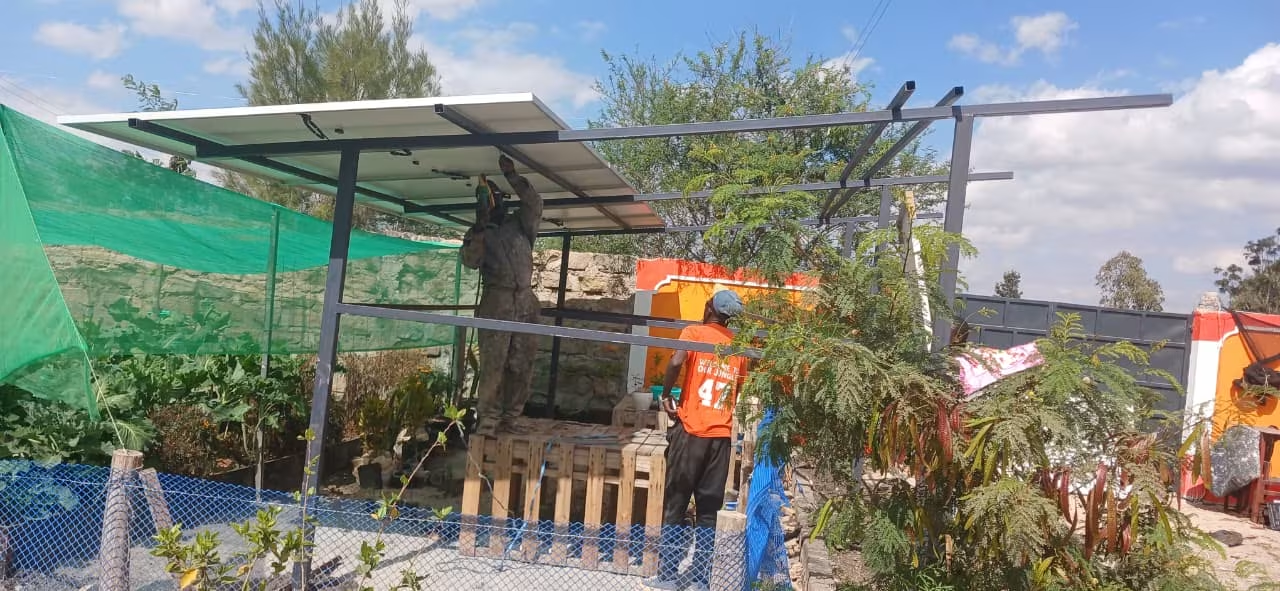
Turnkey solar pumping should describe a complete agreed result, with clear responsibility for the work needed to deliver it. However, the word “turnkey” does not define that result by itself. A useful proposal states the water requirement, source assumptions, equipment, installation boundaries and acceptance evidence. Read those details before relying on the package label.
This guide explains how to define and compare a complete solar borehole scope in Kenya. For the service, visit Masterpiece Hydro-Solutions borehole solarisation. You can also request a scoped project assessment and identify which parts of the water supply already exist.
Define where the project starts and ends
First, draw a simple boundary around the intended project. Does the work begin with an existing operational borehole, a completed but unequipped source, or an undeveloped site? These starting points create very different responsibilities. An offer that assumes a usable pump is not equivalent to one that includes selecting and installing a new unit.
Next, define the delivery point. The contractor might be responsible for water entering an existing tank, rather than reaching every tap or irrigation outlet. Ask which side of that boundary includes pipework, controls and testing. Also, identify any required work by the tank supplier, electrician or another contractor.
Finally, record the final deliverable in plain language. For example, describe the agreed water-supply function and the conditions under which it will be assessed. Avoid substituting “fully complete” for a measurable scope.
Give turnkey solar pumping a water-supply brief
A project brief should describe daily demand, timing of use and available storage. Also, explain which uses have priority if production falls short of demand. The contractor can then assess the proposed pumping arrangement against an actual operating requirement rather than a broad request for solar equipment.
Keep the demand estimate separate from the source’s supported production. A pump’s rated flow does not prove sustainable borehole yield. Therefore, the proposal should identify relevant test results and any limits in the evidence. If the report is old or incomplete, ask what additional assessment is necessary.
For a future expansion, request a separate scenario. This makes the present obligation clear while allowing the contractor to explain possible later changes. It also prevents an uncertain future requirement from silently changing the initial system.
Confirm the design information and duty point
The selected pump must match a stated flow and total head. The design should account for pumping water level, delivery elevation, pipe losses and any required outlet pressure. However, drilled depth and pump setting depth answer different questions. Ask the designer to identify the reference points and source of each measurement.
Grundfos’s pump-selection guidance explains why flow and head belong together. Use that principle when reviewing the proposed duty point. The contractor should be able to show how the equipment relates to the assessed system, rather than presenting motor power as the only selection evidence.
Also, ask who approves design assumptions and equipment substitutions. A turnkey solar pumping agreement needs a clear process for decisions that affect the promised scope.
Build a responsibility matrix for the whole job
List each work package and name the party responsible. Then identify what that party needs before starting and what evidence it must deliver. This exposes gaps between suppliers early. For example, a mounting contractor may require an agreed layout, while the installer may need the tank connection ready before commissioning.
| Work package | Responsibility to agree | Completion evidence |
|---|---|---|
| Assessment and design | Who checks records and confirms the proposed duty? | Recorded assumptions, equipment schedule and design explanation |
| Equipment supply | Who supplies each component and handles substitutions? | Delivered models matched to the approved schedule |
| Mounting and site work | Who provides the structure, foundations and reinstatement? | Relevant design and installation records |
| Mechanical installation | Who handles lifting, rising main and delivery connections? | As-built information and agreed inspection records |
| Electrical installation | Who provides controls, protection and qualified testing? | Applicable test and installation documentation |
| Commissioning | Who witnesses performance and resolves limitations? | Measured results with operating conditions |
| Owner handover | Who supplies training, warranties and operating information? | Complete handover pack and recorded outstanding items |
Identify work that the package excludes
Ask for an explicit exclusions list even when the offer says turnkey. Existing tank repairs, new distribution pipes, equipment retrieval and access improvements may sit outside the proposed boundary. These exclusions are not automatically unreasonable. However, the overall water-supply plan must explain who will complete necessary omitted work.
Also, distinguish an exclusion from an unresolved condition. The contractor may exclude a new tank entirely, while the condition of an existing delivery pipe remains unknown. Record those situations differently. An unknown condition needs an assessment and a decision process, rather than disappearing from the project budget.
For wider equipment scope, review borehole equipping services. Clarify whether the solar proposal includes these tasks or depends on a separate completed installation.
Use a staged example to expose gaps
Consider an illustrative project with an existing borehole, a pump of uncertain condition and a new storage tank planned elsewhere. The owner requests turnkey solar pumping. One bidder assumes the pump and tank connection are ready. Another includes assessing the pump but excludes the tank’s delivery pipe.
First, compare both assumptions against the same project boundary. Neither offer yet demonstrates that every required task has an owner. Next, ask the bidders to clarify the pump assessment, delivery route and tank interface. The owner can then decide whether to include those tasks in one contract or coordinate separate agreements.
This example does not favour one contracting structure universally. Instead, it shows why a complete responsibility map matters. A single invoice can still contain gaps, while several contracts can work if their interfaces are clearly managed.
Separate water approvals from equipment delivery
The project agreement should identify relevant authority requirements and who will manage the supporting records. WRA’s permitting guidance describes construction authorisation and the subsequent water permit process. Ask WRA to confirm the current requirements for your site and project stage.
Do not assume turnkey solar pumping includes every approval or guarantees an authority’s decision. Ask the contractor to explain which submissions or documents form part of its scope. Also, keep the owner’s responsibilities visible. An existing borehole or a change in power source does not remove the need to clarify the water-use position.
For solar-related competence information, use EPRA’s renewable energy information and registers. Verify relevant credentials and the proposed work scope rather than relying on an unsupported statement that all compliance is automatic.
Agree how changes will be controlled
Site assessment can reveal conditions that affect the original brief. Equipment may differ from old records, or the delivery route may need further work. Therefore, agree a written change process before installation begins. It should identify the condition, proposed response, cost effect and required approval.
Next, decide who may authorise a variation. A caretaker’s site access role does not necessarily include approval of additional spending. Give the contractor a clear contact and escalation route. Also, require revised equipment information when a change affects the selected pump, controller or operating arrangement.
Keep the programme consistent with approved changes. A revised scope can affect delivery and commissioning dependencies. Recording those effects helps avoid conflicting expectations at the end of the job.
Set commissioning requirements before mobilisation
The acceptance plan should explain what the installer will demonstrate and under which conditions. Useful evidence may include measured delivery, relevant water levels, control behaviour and the tank filling arrangement. However, a short demonstration cannot automatically establish performance under every future condition.
Also, ask how the team will interpret variable sunlight during tests. The record should distinguish measurements from design assumptions and describe any limitations. If conditions prevent an agreed demonstration, record what remains to be done and who will arrange it. Avoid signing a statement that describes unmeasured results as confirmed.
Finally, check that the witnessed test relates to your actual delivery point. Testing water at the wellhead alone may leave questions about the complete route to storage.
Define the handover pack and operator guidance
Turnkey solar pumping should include an agreed handover process. Request equipment identities, available as-built information, test records, warranty terms and guidance for authorised operation. Also, confirm how the owner can obtain these records later if the person managing the installation changes.
The operator should understand normal controls, useful observations and fault reporting. Qualified personnel should explain safe isolation and the limits of authorised operation. The handover should not encourage owners to alter electrical settings, bypass protection or attempt retrieval work without the necessary competence.
Next, prepare an outstanding-items register. Give each item a responsible person and a clear acceptance condition. If a defect or missing document remains open, record it accurately rather than treating the word turnkey as proof of completion.
Check aftercare across supplier boundaries
A complete scope should explain who takes the first call when a problem appears. Ask whether the main contractor coordinates equipment suppliers and specialist installers, or whether the owner must contact them separately. Either arrangement needs clear responsibilities and accessible records.
Also, distinguish equipment warranty, workmanship cover and optional maintenance. They may have different periods, exclusions and claim procedures. Ask who pays for investigation, transport or retrieval when a fault occurs. Any promised response time should appear in writing and match the agreed service scope.
Keep normal operating records after handover. A simple log of production, faults and relevant changes can help the responsible contractor assess a later problem.
Frequently asked scope questions
Does turnkey mean borehole drilling is included?
Only if the written scope says so. Some offers begin with an existing source and cover solar equipment or installation. Others include a wider project. Identify the starting condition and each required work package before comparing prices. Do not infer drilling from the package name.
Can several companies deliver a turnkey project?
A main contractor may coordinate specialist suppliers or subcontractors. However, the agreement should identify responsibility for their work, records and interfaces. Ask who remains accountable for the complete agreed result and how problems between suppliers will be resolved.
Should every item be supplied by the same brand?
Brand uniformity alone does not prove suitability. The contractor should explain the compatibility and duty of the complete system. Ask for exact model references and relevant manufacturer evidence. Do not accept undocumented substitutions merely because the offer carries a familiar brand name.
What if an existing component fails inspection?
Use the agreed change procedure. First, request the finding and its effect on the original assumptions. Next, compare the proposed response and additional scope before authorising work. An assessment result should remain traceable to the resulting design and commercial decision.
When is the project ready for acceptance?
Acceptance should follow the agreed tests, records and handover conditions. Check outstanding items and record any limitations honestly. A neat installation or a brief period of flowing water does not replace the evidence specified in the contract.
Request a complete and reviewable scope
A useful turnkey solar pumping proposal makes the project boundary understandable. First, define the starting condition and required supply. Next, assign responsibilities and identify exclusions. Finally, agree commissioning, records, operator guidance and support arrangements before accepting the offer.
Discuss your solar borehole project with Masterpiece Hydro-Solutions. Share what already exists and what the completed water supply should do. The next step is an assessed scope with clear obligations, rather than reliance on a package label.